‘Karma’s a bitch:’ MAC commish Jon Steinbrecher’s warning against naked self interest just got more relevant
Looking at you, Texas Tech.
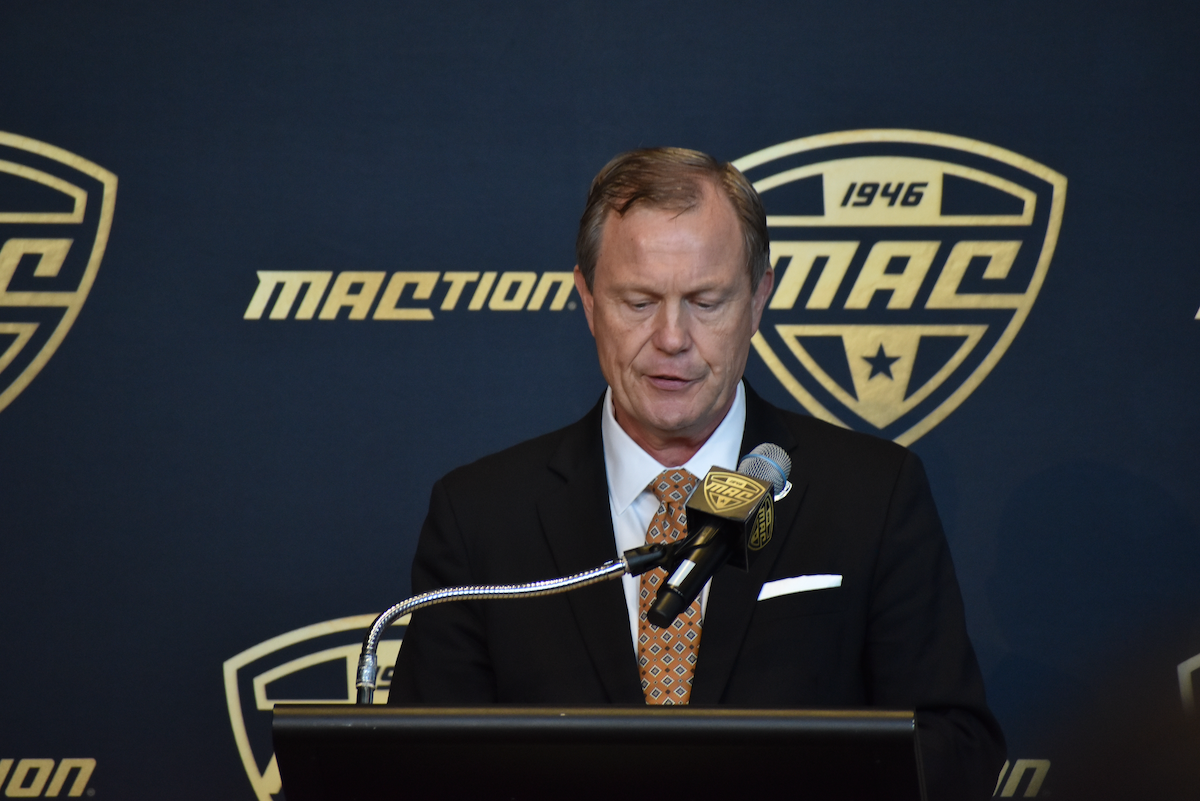
If MAC commissioner Jon Steinbrecher needed any affirmations about his speech at the league's spring meetings in late May, retired Tarrant County judge Ken Curry provided it on Monday morning.
A week and a half after Steinbrecher addressed the gathered members of the MAC, curry, presiding as something of a guest judge in Texas’ 99th judicial district, which includes Lubbock, granted injunctive relief to Texas Tech quarterback Brendan Sorsby, who the NCAA recently ruled permanently ineligible due to a vast history of sports betting rules violations by the quarterback.
The particulars of the Sorsby case are well publicized by now. Earlier this year, Sorsby, via Texas Tech, came clean about a gambling addiction and a years-long history of sports betting that covered his time at previous colleges, Cincinnati and Indiana. It later came out that Sorsby placed upwards of 9,000 bets and gambled around $90,000 in total, and that he made bets on the Indiana football team while he was on the roster, including two bets that were on negative outcomes.
The NCAA ruled Sorsby permanently ineligible and recently denied an appeal to that ruling. Sorsby proceeded with a lawsuit against the NCAA to try and win his eligibility back.
Throughout this episode, Texas Tech, Sorsby and his high-powered legal team have worked tirelessly to cast this as about supporting an athlete through what is a serious mental health issue in gambling addiction. In essence, they’ve argued that by going through inpatient treatment for addiction — something Sorsby has done — and getting to be with his team and play football is the best path for supporting his mental health, something the NCAA has stepped on by ruling him permanently ineligible, in accordance with NCAA rules.
And on Monday morning, Curry agreed with that argument in a brief order with minimal explanation or legal justification for his decision, enjoining the NCAA from withholding Sorsby’s eligibility, meaning he can play in 2026 — at least for now. Sorsby instead will serve a two-game suspension.
The ruling will almost certainly be appealed in court by the NCAA, which issued a statement decrying Monday’s ruling. An appeal may take until after the 2026 season is played, though.
Meanwhile, a firestorm of reaction flared up.
The college sports world, generally, seems disgusted by the whole deal. Sports gambling, particularly on one's own team or sport and the negative incentives that follow, are a third rail for a reason. Just take what Georgia athletic director Josh Brooks said.
UGA AD Josh Brooks with a big statement regarding the ruling today in favor of Sorsby (from @RossDellenger and Yahoo)
— Orin James Romain (@orinromain) June 8, 2026
“I think there needs to be serious conversations about not playing Texas Tech in any sports.” pic.twitter.com/tjrzoGAZFI
Texas Tech lauded the decision, Sorsby issued a brief positive statement, and peer athletic directors around the Big 12 have reportedly been considering a nuclear option in the wake of this ruling: Not playing Texas Tech in any sports.
NCAA president Charlie Baker himself tried to leverage the apparent crisis to rally support for the recently proposed bill in the U.S. Senate that aims to address problems with college sports — one that several lawyers have suggested wouldn’t do anything to address this specific issue.
And all of it, from the naked self interest of Texas Tech not wasting its investment in Sorsby as it pushes to make the College Football Playoff again to Baker using it to cape for a bill that likely wouldn’t do anything to solve this specific issue — or bundle of issues, down to the literal home court advantage of being in a local courtroom — vindicates much of what Steinbrecher had to say.
Steinbrecher didn’t hold back in his remarks to MAC institution leaders, which took about 15 minutes, getting going early with a salvo against the autonomy (AKA power four) conferences, a group he later likened to Lord Voldemort, the villain in the Harry Potter books.
“Like you, I've been observing the continuing evolution of the intercollegiate athletics landscape over the past few years,” Steinbrecher said. “In particular, the persistent and consistent power grab by the autonomy conferences. I am tired of listening to the complaints of the autonomy conferences who believe they know the best way to run the organization. I'm not sure if the right response to all of this is 'Be careful what you ask for, because you may get it.' Or, B, 'Karma's a bitch.'
“Because we're now living with what happens when the autonomy conference's make the rules. The confusion and angst and uncertainty and quite frankly, the ignoring of rules, which is a polite way of saying cheating, has never been greater.”
In general, Steinbrecher's remarks — embedded below and linked here — cast a good share of blame on the autonomy conferences for leading college athletics down the contradictory path of being a big-money sporting enterprise while clinging to the trappings of amateurism.
Further, Steinbrecher, in line with his rule ignoring comment, basically called out programs and leagues being overly self-interested and not looking out for the whole enterprise of college sports in the short and long term. (Steinbrecher himself is admittedly being self-interested here, as the MAC needs the whole of college athletics to be considered to not be ultimately left behind if top programs ever tried to break away from conference and NCAA governance.)
While many have wholly overreacted to the actual legal precedents set by one judge ruling a certain way in a Texas district court, the “get before a local judge who will likely be friendly for local institution” strategy is proving to work well. Will Wade is probably about to put it to the ultimate test in Louisiana with his G-League-turned-LSU team.
It’s about incentives, ultimately, and each step further down the “let’s get a judge to give us what we want, screw the rules” path only encourages competitors to do the same, or go a step further.
Sports leagues work on social contracts being honored, too, to some degree, and the modus operandi in college sports right now is too often to piss on it, instead.
“The challenge is not eliminating uncertainty,” Steinbrecher said. “The challenge is leading effectively through it.”
If you don’t know who Cody Campbell is, he’s a billionaire oil/energy guy from Lubbock, Texas, who is the chair of the Texas Tech board, a major Red Raiders athletic booster and football alumni, and one of the biggest champions of federal reform in college athletics, working closely with stakeholders and legislators in Washington D.C. on legislation.
He also offered up a cartoonishly hypocritical statement which elides a basic understanding of what is supposedly broken with the NCAA system.
“This unfortunate situation is the outcome of a broken system,” Campbell said in a statement. “I’m doing everything I can to fix it, but until there is a permanent solution, Texas Tech and its student athletes have to do the best they can to navigate and compete amid the chaos that exists in the reality of the world we live in.”
I suppose when one has the money that Campbell has, they can deny reality in front of their face and craft their own without much pushback, but there was simply not a thing broken about protecting the very basic concepts of competitive integrity by having hard lines about betting on one's own team. And it was Campbell and his ilk at Texas Tech that got behind this lawsuit that just blew a hole in the NCAA’s ability to convince fans things are on the level.
Texas Tech, Sorsby and Campbell have gotten busy exhibiting the exact sort of behavior that Steinbrecher singled out as problematic. And, in Campbell’s case, have done so while talking out of both sides of their mouth.
Because it’s obviously in Sorsby’s self interest to play and be eligible and not have to subject himself to the NFL’s supplemental draft this summer. It’s also very obviously in Texas Tech’s interest to have eligible the quarterback they signed out of the transfer portal and presumably are paying handsomely to lead them to another College Football Playoff in 2026. Campbell and the other boosters helping Texas Tech build up these rosters obviously have an interest in their investments panning out in wins on the football field.
But it’s equally obvious that they’ve done something that is caustic to the basic tenets of competitive integrity in college sports, too, by pursuing this lawsuit rather than, frankly, taking a bath for making a bad investment and not doing their due diligence on who they signed out of the portal.
But absent rules forcing them to do just that — which a judge just scuttled in this specific case — they’re just following the same incentive that is leading this race to the bottom: Winning matters more than integrity right now.
 Andrew Graham
 Andrew Graham
And the NCAA should own the fact it lost in court on something that should’ve been a slam dunk, too. Had the schools not decided to collectively dig in over the last decades on modernizing the model, the courts might find more often that the NCAA does hold these powers to police and punish players and programs.
But the NCAA, driven by the autonomous leagues, chose opposition and obstinance to the sort of changes that could head off these legal black eyes. Because what Sorsby’s counsel seemingly managed to do is create a contradiction amidst the NCAA’s rules in the judge’s mind, which say the NCAA will permanently make a player ineligible for betting on their own team, but also say the NCAA is committed to supporting athlete mental health.
The path back is not easy or simple, something Steinbrecher acknowledged, and will likely require everyone to give up a little bit of something in the necessary compromises that can deliver college sports and football into a less anarchistic phase.
“Winston Churchill, among others, used to have this great quote and it's something along the lines of, 'Never let a good crisis go to waste,'” Steinbrecher said. “It presents opportunities for us.”
While crisis might be too strong a word — just check the TV ratings for the CFP and NCAA Tournament — for where college athletics are, it’s undeniable that the current paradigm of eroded NCAA governing capacity with nothing filling that void is just leading to a ruthless culture of pursuing self-interest now, perhaps at a cost to the enterprise in the long term.
Because as long as no one is looking out for the entirety of the operation, or has the power to do anything about it, stories like the one coming out of a Lubbock court room on Monday morning will become all the more common.
“We can re-examine our priorities,” Steinbrecher said. “We can modernize outdated structures. We can strengthen educational alignment and we can innovate responsibly. And, we should play a leading role in defining what college athletics should become for the next generation. The future will belong not to those who resist change entirely, nor to those who chase every trend. It will belong to those who can adapt thoughtfully while remaining grounded in purpose.”
And while he might not’ve been able to predict Monday’s machinations, Steinbrecher chose a prescient song lyric to capture the moment of uncertainty for college sports, pulling from “Uncertain, TX,” by Kacey Musgraves featuring Willie Nelson.
Here in Uncertain, Texas
Nobody ever makes up their mind
Down here in Uncertain, Texas
Nobody ever makes up their dusty, old, love-bombin'
Snake-charmin', bullshitin'
Heartbreakin', godforsaken, dumbass mind
“Excuse the language, that’s Kacey and Willie, not me, but I shared it with you — again, maybe mimics some of the behaviors right now,” Steinbrecher said.