Laying out the optimistic, pessimistic cases for Central Michigan in 2026
The Chippewas have high hopes for 2026 and the tools to accomplish their goals, and of course could be undone in a few key spots.
Editor’s note: Mitten Football will dig into the rosier and dimmer potential outlooks for all five of the FBS teams in Michigan over the summer, with installments coming regularly. This week (still in reverse alphabetical order), things keep going with Eastern Michigan.
Read the first installment on WMU here, the second installment on MSU here, the third installment on Michigan here and the penultimate installment on EMU here.
Short of hanging on for a win in Kalamazoo and doing a little better in the bowl game, Year 1 for Matt Drinkall and Co. at Central Michigan went swimmingly.
Inheriting a program in a state of disarray at the end of Jim McElwain’s tenure, the new staff went hard through the first offseason and parlayed whatever happened over those eight months into a 7-6 final result in 2025, with CMU’s first bowl berth since 2021 to cap it off.
Now CMU is an outside contender to win the MAC, certainly a goal for everyone in Mt. Pleasant as Year 2 is set to kick off for this coaching regime. There’s plenty to like and, of course, a handful of pressure points that could scuttle the good vibes.
So, let’s dig in on the Chippewas.
The case for optimism
- A deep, veteran offensive line
Two returning starting tackles and more starts back along the interior is a good way to build the foundation of an offense.
So with Jacob Russell (LT), Martin Koivisto (RT), Dasan Smith (LG), Brady Ploucha (RG) and Ryan Blum (C) all back, plus transfers the coaches are pretty excited about (hello, Losini Maka), CMU should have one of the best offensive lines in the MAC.
It’s not a surprise to see so many guys coming back and transferring in to play for Drinkall’s program. The offensive line is highlighted in how they play offense, and Drinkall himself has plenty of street cred — he coached Army to a Joe Moore Award not too long ago. That makes an impact.
So with experienced, physically developed men playing offensive line, Drinkall and OL coach Hayden Mace have all the necessary clay to mold this into the best unit in the MAC and perhaps even better than that.
The running back room in Mt. Pleasant rejoices.
- Settling into an offensive identity
The 2025 season was a little bit of Drinkall and OC Jim Chapin taking the ingredients they had, throwing them into the pot and making a pretty good stew. This year, to fully torture an analogy, they got to shop for their intended recipe.
There will still be plenty of heavy formations and power running of the football, but as Drinkall repeatedly said in the spring, they won’t be taking the air out of the ball as much and trying to condense games. There’s more desire to get the ball out to the perimeter and downfield and expand the run game, including the quarterback’s involvement in it.
This is to be expected for a Year 2 coaching staff as they turn over the roster to look more how they want it, and Drinkall and Co. have benefitted from point No. 1 in this exercise, with an offensive line that is ready to compete for a conference title right now. That helps everything else come into focus.
And with quarterbacks going on another year with Chapin, who coaches that room, the Chippewas are very bullish on how the offense can take a step forward and start to be a more aggressive, assertive machine.
- A promising, transfer-heavy secondary shines
Defensive coordinator Sean Cronin is working with an almost entirely new deck on defense in 2026, with few returning starters from last season.
But at least one part of the defense came out of spring looking like the Chippewas hit on the right players in the portal, as the secondary looked sharp. CMU went after some older and experienced transfers like Justin Taylor out of Wyoming (previously Wisconsin), Darrell Bryant Jr. from Northern Colorado, Ty Williams out of Butte College and Matthew McKenzie from Bethune-Cookman.
There are a handful of others and some younger players the Chippewas are excited about, plus the returner Jaion Jackson, who started at outside corner in 2025, but it’ll be a transfer-heavy outlook for the secondary in 2026 and that seems to be quite alright.
In particular, this seems like a secondary with a lot of positional versatility and a number of the older players were cross training between safety and cornerback throughout spring. There should be options for Cronin and Co. to mix and match personnel on the back end if it all pans out just right.
 Andrew Graham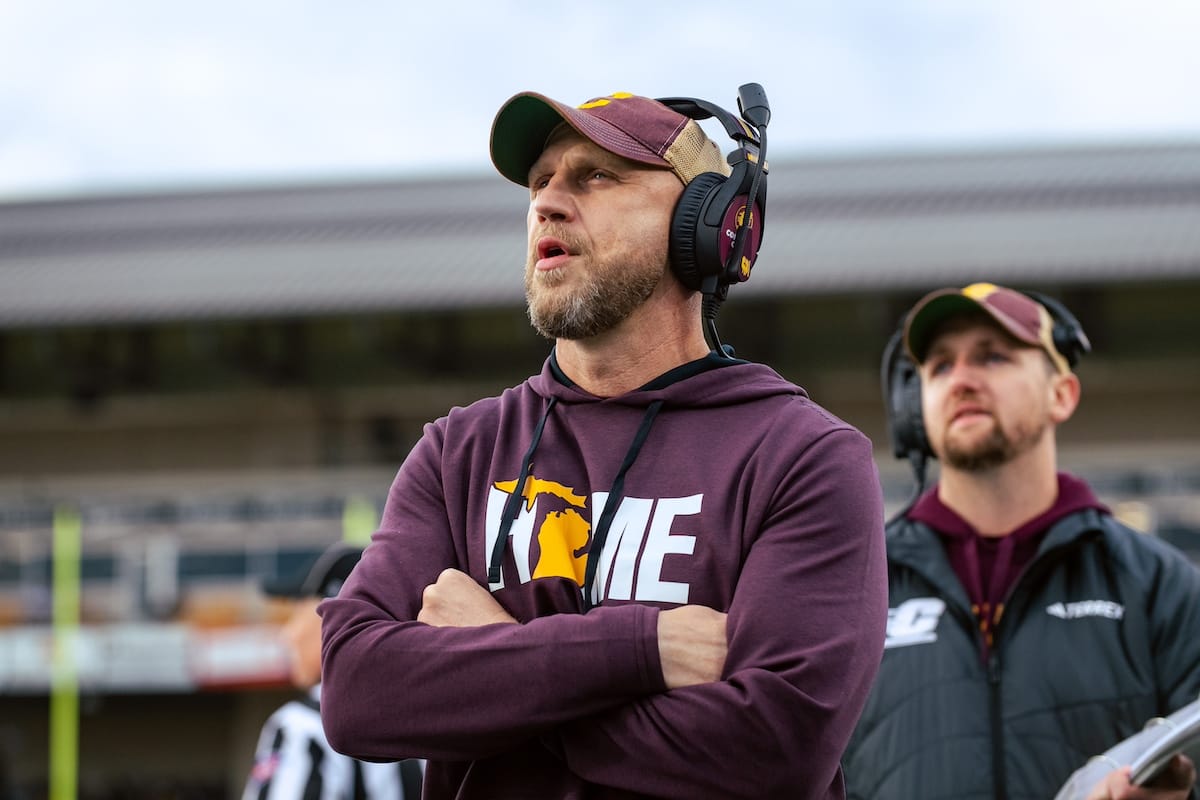
 Andrew Graham
The case for pessimism
- A new-look front seven struggles to make an impact
Michael Heldman did quite a lot for this team defensively in 2025, as did Jordan Kwiatkowski and Dakota Cochran. They’re all graduated and out of eligibility, with Heldman looking to make the roster for the New Orleans Saints.
In their stead, CMU will use a mix of transfers and just a smattering of returning players like edge rusher Korver Demma or rotational linebackers stepping into bigger roles like Victor Earl, among others.
And while it was probably always likely to see a big dip in production with an NFL-caliber edge rusher leaving campus, there could be a notable fall off across the front seven for the Chippewas.
Cronin made hay last year by leaning on the experience he had up front, but won’t have quite the same luxury in 2026. And if the fall off in ability in production is bigger than expected, it could make defending a difficult proposition.
- The passing game can’t shift into higher gears
Joe Labas, who managed to be hyper-efficient as a passer in a rather small sample last year, is out of eligibility. Now it’s up to Angel Flores, Jadyn Glasser and Marcus Beamon to take the reins, collectively or if one rises above the rest.
And the big question is how much CMU can get the ball moving in the air with those three. It’s a well-worn point for anyone familiar to Mitten Football, but it bears repeating that Glasser is the most experienced D1 passer of the trio and he’s gone 48-of-85 for 517 yards and two touchdowns with four interceptions so far in his career. Most of that production came in 2024 when he was a true freshman.
There’s a lot of belief internally in these quarterbacks and Glasser, specifically, has the highest evident physical upside as a passer, but it’s still more theoretical than real entering this year.
And to boot in passing game related hang ups, losing Tommy McIntosh for the season with a torn ACL from spring practice just bites. He was set to form a nice pairing with Langston Lewis at wideout, and now Lewis will need to perhaps shoulder a bigger role, or others will need to step up.
- It’s a hard schedule
Now, no one inside the Chippewa Champions Center will shy away from the challenges coming on this schedule, it’s undeniably a tricky slate.
In the non-conference, outside of hosting Colgate, the Chippewas travel to south Florida to face Miami (FL) fresh off a national runner up season, and will open the season with a trip to see the feisty New Mexico program under Jason Eck. That team gave Michigan fits in Ann Arbor last year, and the CMU staff is fixing for a stiff test.
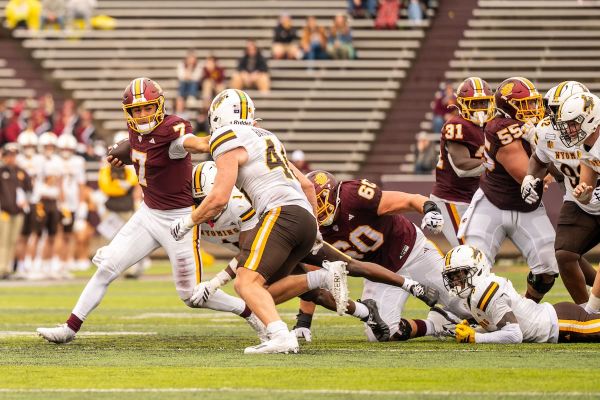
Oh, and the fourth non-conference game? Wyoming comes to Mt. Pleasant in Week 3, another strong G6 program.
Then in MAC play, CMU will face Miami (OH), Ohio, Western Michigan, and what should be a solid Eastern Michigan team, among others.
There are just few “easy” wins on this schedule, one way or another.