A scene from ‘The Wire,' plus 9 thoughts on MAC commissioner Jon Steinbrecher’s media day remarks
The MAC commissioner seems to understand the moment, but maybe could've been more direct in communicating it.
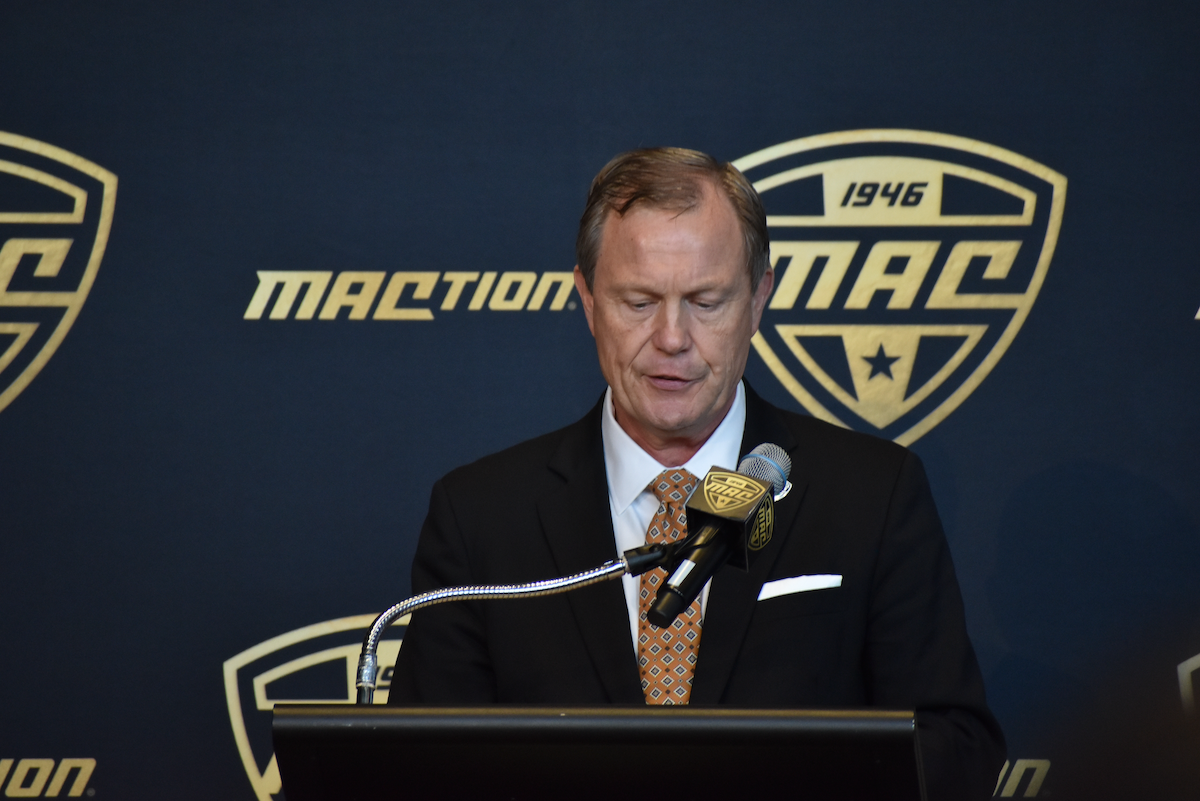
Detroit — As MAC commissioner Jon Steinbrecher stood at a lectern at Ford Field on MAC media day on Wednesday and spoke about the state of college athletics, where the conference he leads fits in, and where this might all be headed, a scene from the HBO drama “The Wire” came to mind.
Early in the first season, after news breaks that a state’s witness had been murdered, the Baltimore Police Department and powers that be are eager to throw the public and media off the scent. Detective William “Bunk” Moreland, the lead detective on the case, plays along with the charade, and downplays the witness angle at a press conference. Watching on television are his homicide unit partner, Jimmy McNulty, and narcotics detective Shakima "Kima" Greggs.
McNulty, true to his character (as those who have watched know), is disgusted by the affair.
“Ah, Bunk,” McNulty says. “Shame on ya, lad.”
“What’d you expect him to do?” Greggs says in response.
“I dunno, grab the mic, shove [Major Bill] Rawls to the ground and declare all of Baltimore should rise as one because they’re murdering witnesses in cold blood,” McNulty says as he turns off the TV.
While Steinbrecher has lately been unabashed in calling out the excesses, hypocrisy and bellyaching of the autonomy conferences and their members, his address on Wednesday sounded closer to being stuck between defiance and crying out to not be left behind.
He extolled how the MAC has carved out an integral place in the history and tradition of college football and spoke about how things like competitive success and academic excellence aren’t inherently opposed goals. He also spoke about potential College Football Playoff expansion — the MAC has no officially formed position, he said — and the MAC’s obvious desire to get a team in the tournament and how expansion of the field shouldn’t be for the sake of more spots, but “enhancing” the sport of college football.
“In a time when many are questioning the future direction of intercollegiate athletics, we can demonstrate that excellence, integrity, innovation and educational purpose are not opposing ideals, they are shared commitments,” Steinbrecher said.
In essence: We’re worth more than being cast aside in this rapidly professionalized world of college football and, more generally, we needn’t wantonly discard many of the trappings of college football as we’ve known it.
An apt message, but one that didn’t convey the bottom line.
With the SEC openly musing about jumping from the NCAA and doing its own thing, and the possibility looming of the Big Ten joining them as they pick off various high-value targets to bring along with them, Steinbrecher fielded a question on that possibility.
“It’s hard to have national championships without a national structure,” Steinbrecher said. “I understand the conversations they’re having. We’ll leave it to them. We’ll continue to work collectively with our partners to make the entity we have stronger, better, more efficient, and we’ll see how that goes.”
Or maybe we all just need Bunk Moreland calling for the non autonomy conferences to rise up in rebellion.
To keep things rolling, here are nine more thoughts on Steinbrecher’s remarks amidst the current state of college football.
1. Not to just totally discount everything you just read (I promise), but it is worth remembering any time Steinbrecher or someone of his ilk offers prepared remarks like that, it’s in essence a political speech.
There are the internal MAC and NCAA politics of it all, and then of course the actual outward national politics now with Congress in the mix. And pulling a punch can be a tactic, after all.
2. It’s important to remember what we’re fundamentally talking about: The SEC and Big Ten — plus a selection of other top-tier schools they convince to come along with them and leave behind the NCAA to set their own rules how they want (presumably through collective bargaining if they don’t want to get sued a la the NCAA).
3. While I certainly can’t blame any involved parties from wanting to free themselves of NCAA rule and all the current legal entanglement, it's worth remembering these schools are the NCAA.
And while college athletics are in a turbulent, transitory time, getting on the last life raft and saying bon voyage to whoever’s left on a ship that could likely be salvaged if they didn’t otherwise do that kind of feels like the vibe if the SEC, Big Ten and others bolt.
4. SEC saber rattling this week makes Big Ten media days next week a fascinating litmus test.
Both conferences are still opposed to the Protect College Sports Act, and if the Big Ten coaches, ADs and commissioner echo the sentiments from Tampa about leaving the NCAA, it ups the ante, even if it’s just as a way to exert leverage over some draft legislation.
5. If the Big Ten takes a different tack, it creates a fascinating rift.
Because a Big Ten which remained in the NCAA without the SEC would, presumably, dominate. Likely even still in a post-PCSA world where part of the competitive advantage it built over decades is eroded.
And the SEC would still presumably be spending a hell of a lot of money to play what would likely be very high level football. But does a purely regional league move the TV needle the way a national conglomerate would?
6. We’re also talking about Nielsen media markets and endowments mattering, here. The former is of particular import when negotiating the league TV deals that keeps the lights on.
It’s worth remembering the Big Ten has teams in the New York, Los Angeles and Chicago media markets — the top three in the country — plus Washington D.C. (No. 8), Seattle-Tacoma (No. 13), Detroit (No. 14), Minneapolis-St. Paul (No. 16) and Indianapolis (No. 25).
The SEC has plenty of punch in this regard, too, but not the same level of foundational wealth across the Big Ten.
7. It’s also worth remembering the SEC and Big Ten are not going to be keeping all the teams currently in these leagues if they decide to break off, which also probably creates some internal inertia against such a move — or at least makes it so it’s really a school and not league level breakaway.
Why would the not-so-proverbial Mississippi States and Northwesterns get in line for a move that puts them on the cliffs edge next?
8. Since this is all about how the economics of not paying athletes has broken down, ultimately, it does seem apt to point out the NFL shares massive revenues close to equally between owners and players, has a salary cap, and does various forms of intra-league socialism to ensure competitive balance, and you know what happens?
The line keeps going up for both sides, as NFL teams continue to sell for billions of dollars and the salary cap has risen precipitously while the TV revenues keep flowing in.
9. Compromise requires that everyone give something up to get something they want; it will cost everyone something — somehow, some way — and perhaps just for the return of a greater, greater good.