Laying out the optimistic, pessimistic cases for Michigan in 2026
Michigan is ushering a new coaching staff, departing from the Harbaugh umbrella and setting the stage for an intriguing 2026 campaign under Kyle Whittingham.
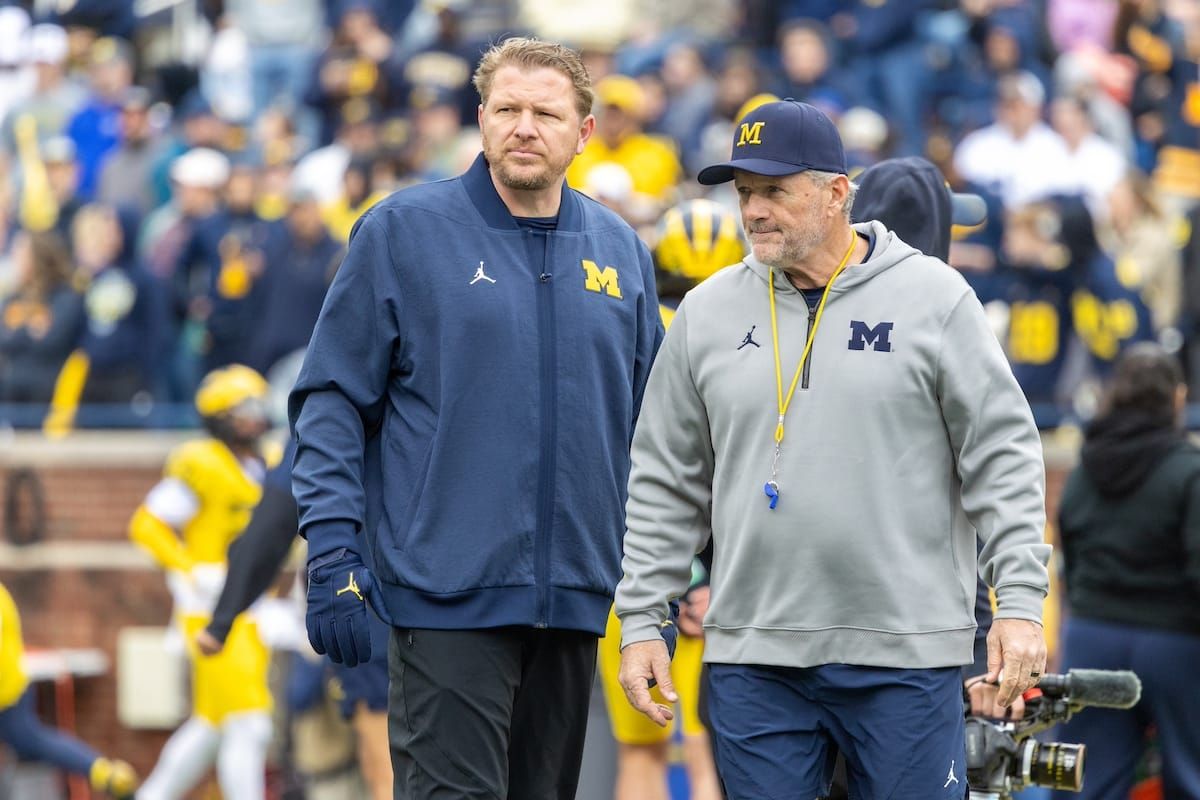
Editor’s note: Mitten Football will dig into the rosier and dimmer potential outlooks for all five of the FBS teams in Michigan over the summer, with installments coming each weekend. This week (still in reverse alphabetical order), things keep going with Michigan.
Read the first installment on WMU here, and the second installment on MSU here.
It's a new era in Ann Arbor, with Kyle Whittingham parlaying two decades of success at Utah into what will likely be his final head coaching job as he leads Michigan into the 2026 season.
He's overhauled the coaching staff, managed to retain the core of the roster and accentuated with a handful of transfers. He's got a once-heralded quarterback prospect looking to improve in Year 2 and a strong offensive ecosystem around him, and plenty of questions (and potential answers) for how the defense might shape up.
There's a lot to be excited and trepidatious about for the Wolverines in 2026.
Let's dig in.
The case for optimism
- Better leadership in Schembechler Hall
Without relitigating the seeming lack of any managerial oversight under Jim Harbaugh and thus the misdeeds that were allowed (Hello, Mr. Stalions) or the out-and-out scandalous end to Sherrone Moore’s tenure, it’s safe to say the Michigan football program needed some, for lack of a better term, boring-ass adults running the program.
And while Kyle Whittingham himself is actually a sort of fascinating figure (he rides his motorcycle and works out religiously), he’s certainly a much more placid, reined in person than either of his predecessors as Michigan. And he’s brought in a well-respected coaching staff, mostly with names familiar to his Utah and BYU-centric coaching circles while retaining a handful of holdovers, like Tony Alford.
Already, there’s been an impact.
Throughout spring, Michigan players spoke about heightened standards within the program for things like punctuality, academics and the way they go about their football work. Plenty was made about the strength and conditioning program turning up the wick, too.
It’s hard to say how this concept translates to wins and losses on the field, but it’s hard to imagine Michigan isn’t going to be better off in 2026, and going forward, with a coaching staff that’s seemingly far more put together and on top of things than previous ones.
- A great offensive ecosystem around the quarterback
This is quarterback independent, to be clear. It’s a consideration of what Michigan has around Bryce Underwood that should lend to success and easier situation for him.
Starting with the offensive line, Michigan has four returners with notable starting experience: Evan Link, Blake Frazier, Andrew Sprague and Jake Guarnera. Guarnera appears poised to move from guard to center, and Frazier and Sprague started a bulk of games at left and right tackle, respectively, last year. Link has also played tackle, but has some guard versatility and is coming off an injury.
In the backfield, Michigan might have it’s best collection of talent with the one-two punch of Jordan Marshall and Savion Hiter. There aren’t going to be many running back duos in college football with more talent than that pairing.
As for the tight ends, Michigan will likely be leaning on the likes of a healthy Hogan Hansen, Zack Marshall and Deakon Toneilli to keep building on 2025.
Receiver is slightly tricky, as Andrew Marsh is clearly one of the bright young talents at that position and is coming off a strong freshman campaign. His rapport with Underwood was evident. But outside of Marsh, there’s oodles of talent but less track record. JJ Buchanan also had a promising freshman season at Utah in 2025, but with a different quarterback. Jaime Ffrench was a five star recruit but didn’t crack the lineup (albeit in a loaded Texas receiving corps) as a true freshman. Either way, it’s hard to argue the talent isn’t better than it was a year ago, and certainly deeper.
And the last piece of this is Jason Beck, who is highly regarded by plenty of his peers in the profession and is coming off back-to-back years where he’s coordinated a Top 25 offense (it was Top 10 in 2025), first at New Mexico and then at Utah last season. He’s especially adept at fielding highly-productive rushing attacks.
It’s not that this whole picture makes it so Underwood lives life on easy mode in 2026, but the Wolverines have seemingly a full bag of clubs to try and play offense how they want in 2026 if all goes to plan, and can likely lean on a strong run game as the foundation.
- Your best defenders rush the passer and play corner
Michigan’s defense should be solid again in 2026, though certain parts of the unit will be rather transitional, like the linebacking corps where a lot of young, new or young and new players will see the field. But with John Henry Daley coming off the edge and Jyaire Hill covering half the field or a team’s top target, Michigan has a good starting recipe for its defense.
And it basically comes down to two factors being highly influential in how your defense looks and feels: Rushing the passer and covering. There are other things, like tackling and pursuit, but being able to have someone who commands a double team up front, or can win a one-on-one if you give it to him coupled with an elite cover corner is a defensive 1-2 punch that can give a team fits.
The real force multiplier is how they can play off each other, too. Hill blanketing receivers keeps the ball in a quarterback's hand; Daley bearing down on a quarterback means they can’t sit tight and wait for a receiver to eventually uncover.
Now, two players aren’t enough to make a defense good, but Michigan has talented players around the defense, albeit some unproven ones in spots. But what the Daley-Hill combo allows for is Michigan to have a raised ceiling on defense.
They should be good and productive no matter what, but in the universe where Michigan’s defense looks solid in the other nine spots, those two could be on serious pedestals leading a smothering unit.
Also, don’t forget about Zeke Berry and Smith Snowden. Michigan should be able to cover and rush the passer in 2026.
The case for pessimism
- The passing offense doesn’t get better
Michigan’s passing offense was not good in 2025. It will likely be, at a minimum, a degree better in 2026 because the quarterback returns, the skill talent has improved and said quarterback has a dedicated position coach now (see again: adults in the room.)
But it also doesn’t stretch the imagination that Underwood is better but not great passing in 2026.
He finished 2025 playing all 13 games and completing 60.3% of his passes (202/335) for 2428 yards, 11 touchdowns and nine interceptions. He was adept with his legs, too.
Underwood flashed moments of absolute brilliance with his ability to move and the fact there are just not a lot of humans his age with his physical skillset. But for every time he uncorked a throw that few people can make — and sometime inaccurately — he seemed to have a corresponding error. His rash of interceptions against Northwestern late or his red zone issues against Purdue come to mind.
In general, the analogy of the fireballing pitcher who can’t quite get his stuff under control seems to hold up. And he’s certainly still capable of evolving past that, but the pessimistic case is that he struggles to do so in 2026.
And, to boot, outside of Marsh, it’s hard to gauge the chemistry and feel that Underwood will build with his new group of receivers. They may just be a year away. In the case where things go sideways for Michigan, there’s probably some element of Underwood and the passing game struggling to make things click.
- Struggling to control the line of scrimmage defensively
Michigan’s defenses in the late Harbaugh and two-year Moore tenure were largely good because they owned the lines of scrimmage. Easy to do with Mason Graham and Kenneth Grant, and still quite possible with Michigan’s cadre of defensive lineman in 2026, with some diminishing returns.
Well, most of the guys who were part of that are gone. It’s another spot where the Wolverines are betting on transfers or up-and-comers to be difference makers.
There are some evident choices, like Utah transfer DL Jonah Lea’ea and returning DL Trey Pierce. But the biggest gap between this front seven for Michigan and in years past is the depth.
The possibility that this year is big for seasoning most of the younger front seven players as they rotate through alongside the more proven players isn’t a far fetched one. Plus the linebacking corps is quite murky at this point with Jimmy Rolder graduating and Cole Sullivan transferring to Oklahoma.
It’s not likely that Michigan will fall off a cliff in this regard, but having to face really rugged Big Ten offensive lines could look a little worse than it has in years past. And that makes a big difference at the point of attack.
- Lack of standout safety play
This feels quite picayune on its face, yes, but if Rod Moore is again limited in some capacity by what’s become a years-long saga with his surgically repaired knee, the safety position gets quite interesting for Michigan.
It’s not for lack of talent, but the options behind Moore are either new or very unproven.
Jordan Young played notably last year but in a narrow role as a rotational piece, appearing in 10 games. Mason Curtis played significantly in 2025, too, but is more of a box player.
Chris Bracy, a transfer from Memphis, has earned praise through the spring but his fit and role isn’t entirely clear yet. Jacob Oden, Jordan Deck and a few other young players could be fighting for more playing time.
And then there’s Taylor Tatum, who transferred from Oklahoma and moved from running back to safety. What’s hard to gauge is whether that was driven by the talent in front of him at running back or a need at safety.
Either way, having safeties that are quasi-coaches and know what’s happening in front of them like they drew up the concept are invaluable. Moore is that type of player at this point in his career. It’s unclear if any of the rest are that capable for Michigan, and what the safety position would look like if Moore is limited.
And once more, it’s not that it would be bad, per se, but that it wouldn’t be a potential difference maker for a defense that doesn’t have one on paper outside of Daley or Hill.