Laying out the optimistic, pessimistic cases for Michigan State in 2026
The Spartans are charting course on a new era in 2026, with plenty of reason to hope for the best — and plenty to be cautious about, too.
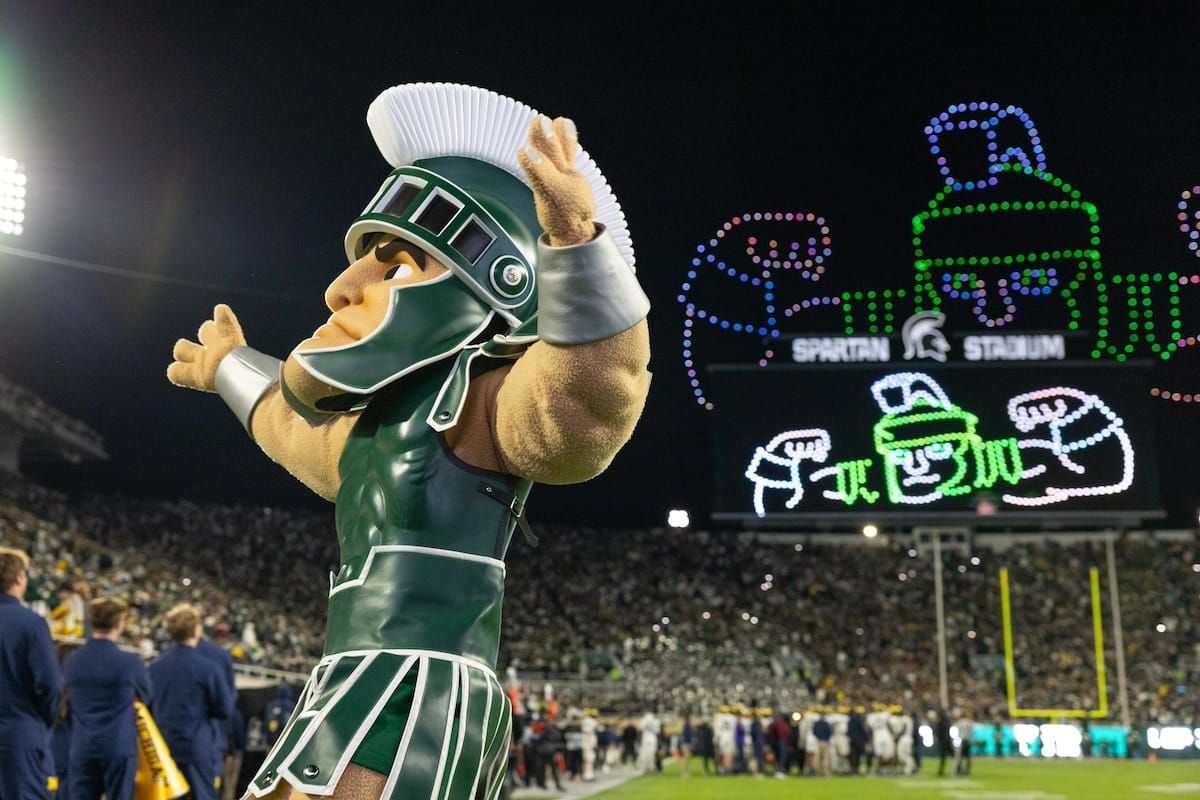
Editor’s note: Mitten Football will dig into the rosier and dimmer potential outlooks for all five of the FBS teams in Michigan over the summer, with installments coming each weekend. This week (still in reverse alphabetical order), things keep going with Michigan State. (Also this is published later than intended due to last minute Tigers coverage by this author for The Detroit News. We hope you won't begrudge making sure bills get paid.)
Read the first installment on WMU here
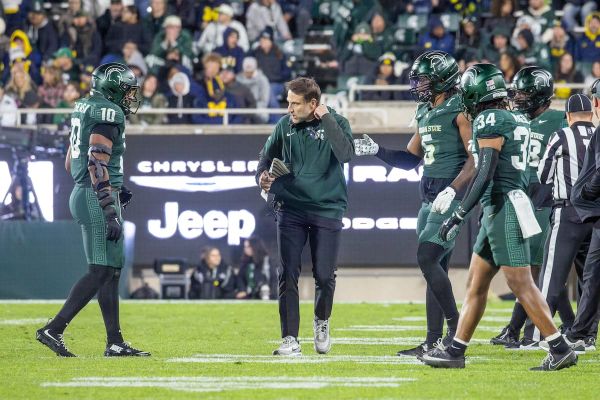
It’s been a whirlwind few weeks for Michigan State athletics, but all the while Pat Fitzgerald and Co. are working on the designs for a debut season for a new-look Michigan State program in 2026.
“Really what I felt strongly that we needed when I got here was the standards, the expectations, the urgency, the discipline,” Fitzgerald said earlier this offseason.
So far, all there’s been to go on has been a transfer haul, finishing off the 2026 signing class and spring practice, but there’s still plenty to glean about how the Spartans might want to operate. And before Fitzgerald and this new era of Spartan football begins in earnest, it’s worth considering what the best and worst case scenarios might entail in East Lansing this fall.
Let’s dig in.
The case for optimism
- The cultural overhaul takes root
This is admittedly rather nebulous relative to things like considering tackle depth or continuity with a defensive play caller, but it’s real and it matters.
For all his real abilities coaching ball, Jonathan Smith just always felt like a fish out of water at Michigan State. There was a disconnect somewhere. It’s impossible to judge how well Pat Fitzgerald and Co. will do in that regard, but he’s already off to a better start and has a more evident track record to lend himself real buy-in from not just his players and assistants, but folks around East Lansing and Michigan.
The real place that MSU is targeting in this regard is what’s boiled down into “The Spartan Way,” a process that’s been quite intentional in forging a rugged, tough, and relentless mindset among the individual and collective. It’s part of why Fitzgerald was gung ho on hiring Joel Welsh to be the head strength and conditioning coach, bringing some DNA from the Iowa Hawkeyes to East Lansing — he added more with special teams coordinator LeVar Woods, more on that in a minute.
But in general, while this is a little about Xs and Os insofar as the toughness and ruggedness translating via MSU’s ability to block and tackle, the right ideology is there.
This team wants to be like those Mark Dantonio teams that just choked opponents into submission for 60 minutes, spit ‘em out and then asked what’s next.
Overall roster talent might cap out how far this mode of playing can take MSU in Year 1. But if this team has the look and feel of the types of Big Ten teams that are, for lack of a better term, massive pains in the ass to play and even more difficult to beat, this program can start to carve out a new niche of success in the Big Ten.
- Joe Rossi and LeVar Woods deliver
MSU has two of the more well-regarded coordinators in the conference in Rossi (defense) and Woods (special teams). Woods, who also is MSU’s assistant head coach, may well be the best at that role in the whole of the country, though there’s plenty of contenders. But in general, if both Rossi and Woods work their magic, it should provide MSU a great floor.
Rossi did good work down the stretch with the defense last year, navigating a dearth of pass rushing ability well by getting creative in the back end and dialing up creative pressure packages.
There’s a chance he has to deal with some similar constraints getting after the passer, though MSU reloaded that room heavily in the portal. But Rossi took a defense that gave up 38 points per game in the first five Big Ten contests last season and turned around to give up 24.75 in the final four games of the season.
There’s a reason his contract got set up for him to last in East Lansing, and Fitzgerald evidently sees the value. And that transfer class of defensive backs looks really promising.
As for Woods, outside of kicking, MSU’s special teams has been bad to disastrous at times in recent years. The Spartans lost a game to Iowa in 2023 in large part because of a massive special teams play late with Woods leading that unit for the Hawkeyes. It happened again in 2025, too.
There’s no stopping Kaden Wetjen 😤
— Big Ten Football (@B1Gfootball) November 22, 2025
His return TD against Michigan State marks the sixth of his career and a new school record for @HawkeyeFootball 🔥 pic.twitter.com/1aqboH6aWp
Basically, if the Spartans can eschew the bad plays and build a special teams unit that’s consistently taking hidden yardage and putting the offense and defense in advantageous positions, that’s a massive floor raiser for a program in Year 1. And Woods is as good a pick as any to make that happen.
Having to replace Ryan Eckley does sting, no matter what, though.
- Offensive line, pass catchers change the conversation about the offensive ceiling
Right now, before fall camp or a down of football has been played, it’s probably reasonable to feel OK about MSU’s running back room and hopeful about Alessio Milivojevic as a full-time starter.
The offensive line and pass catchers, though, are really big areas of uncertainty. MSU added a spate of transfers to beef up the offensive line and the pass catchers welcomed KK Smith (Notre Dame) and Fred Moore (Michigan) to bring experience alongside Chrishon McCray and (perhaps, NCAA waiver depending) Rod Bullard.
Either way, MSU is going to be betting on the likes of Robert Wright Jr. and Ben Murawski to help the returners anchor an offensive line that shuffled through countless combinations in 2025 and those transfers and likely some youngsters to step up at receiver. The tight end position with Carson Gulker also looms.
Basically there’s a lot up in the air and a lot of players unproven at this level or program vying to step in and make plays on the offensive line or at receiver and tight end. And in the case for optimism, that’s a good thing. Because if the newly remade offensive line turns out to be a mauling group and the pass catchers have real juice, or even one of them emerges as a hard-to-cover threat the defense needs to account for, it can drastically raise the ceiling of this offense into something rather dynamic.
And any pop of outside receiving threat coupled with a rock-steady offensive line could be the final offensive piece that really ties the room together.
The case for pessimism
- A one-dimensional offense gets hemmed in
The Spartans want to be a rugged, run-the-ball type of offense. And while they should be somewhat capable of doing that with the remade offensive line and running back corps., but it’s not hard to imagine the reality where the receivers are coverable and defense start to tee off with loaded boxes.
Absent a wide receiver or tight end making a big leap through the offseason, or one of Smith and Moore really impressing, it’s not likely that MSU has a receiver on the roster that strikes fear into opposing coordinators. Create problems? Sure. Torpedo game plans? Not so much.
And if MSU is reliant on getting movement on the ground and running backs making the most of their touches, things could get slogging and fast.
Even if MSU is good on the ground, good defenses will make it so that alone can’t win the Spartans a game. And it’s worth wondering how much the individual and collective talents in the backfield and offensive line can really provide explosive, chunk plays like a passing offense can.
It’s just not hard to see the reality where MSU doesn’t have much threatening outside, and whatever talent there is on the line and at running back eventually gets overwhelmed.
- Alessio Milivojevic needs some seasoning
The last glimpse of Milivojevic was tantalizing, dicing up the Maryland defense to the tune of a nearly 70% completion rate, 292 yards and four touchdowns, plus an interception.
But the prior three games of his run of four starts at the end of the year are a slightly different story. Across those games, all losses (including two heartbreakers), Milivojevic completed just under 64% of his passes for 231 yards per game and a touchdown per game.
So while Milivojevic gave Michigan State a chance in his starts and dominated the Maryland game, it’s fair to wonder what he looks like as a full-season starter, entering as such from the offseason. There’s certainly benefits to be had there, but the live action might be the seasoning he needs to really come along and be a different maker.
In short, it won’t be a stunner if Milivojevic needs some time to really hit his stride as a full time starter in a new offense with lots of new weapons and pieces around him. It’s possible he hits the ground running and is some force multiplier in the offense, but it’s probably more likely that he’s closer to the quarterback he was in the three games prior to the season finale.
And that’s still a good player, but one who gives the offense stability more than upside.
- Schedule and roster talent have MSU behind the eight ball
These are two things that are, really, not entirely in control of the new coaching staff.
For one, they brought in a lot of promising transfers but that’s all still mostly projection until proven otherwise, and retained some solid pieces from last year's team. But the general state of the roster is not that of a team that will compete in the top half of the Big Ten, at least barring some notable strides by players at key positions (OL, pass rush, WR). It could feel that way by the end of 2026, surely. But in June, this not the case.
And that gets to the transitional point, that MSU is one of the main teams dinged by the Big Ten adding the likes of Oregon, Washington and USC — it moved the middle class of programs prior (MSU, Minnesota, Wisconsin, Iowa, etc.) and more or less artificially depressed them in the pecking order. It’s not that MSU can’t reach the top, but the climb is more daunting.
Which leads to the schedule: MSU plays at Notre Dame, Nebraska, at Wisconsin, Illinois, at Michigan, Washington and Oregon.
It’s unlikely that MSU is favored in any of those games, and matchups against Northwestern and UCLA are probably tossups right now. Most betting lines have the Spartans somewhere in the 3.5 to 5.5 win range. And while that’s not predictive, it’s informative.
And in fairness, a couple of teams we expect to be good will be bad, and a couple we expect to be bad will be good. Some of them could be teams Michigan State plays. But simply, right now: The Spartans won’t be favored in many games they play come fall, and that’s reason to be pessimistic.