How WMU’s ‘Boomer’ came to be, the bigger legacy it fits in
ROTC instructor and former U.S. Army sergeant major Joe Guilfoyle might've been a driving force behind Boomer, but the story runs much deeper than a cannon and a man.
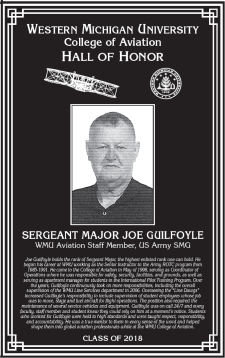
Kalamazoo — Joe Guilfoyle cuts an unassuming image, a retiree now in his 80s, working part time at a hardware store as he resides in Southwest Michigan.
A former sergeant major in the Army — the highest rank for an enlisted soldier — who deployed to Vietnam, made a peacetime career in the army, twice getting posted in Korea and later went on to become an instructor in the Western Michigan ROTC program before eventually finishing his time as a Bronco working on staff at the aviation college, Guilfoyle seen his share of the world.
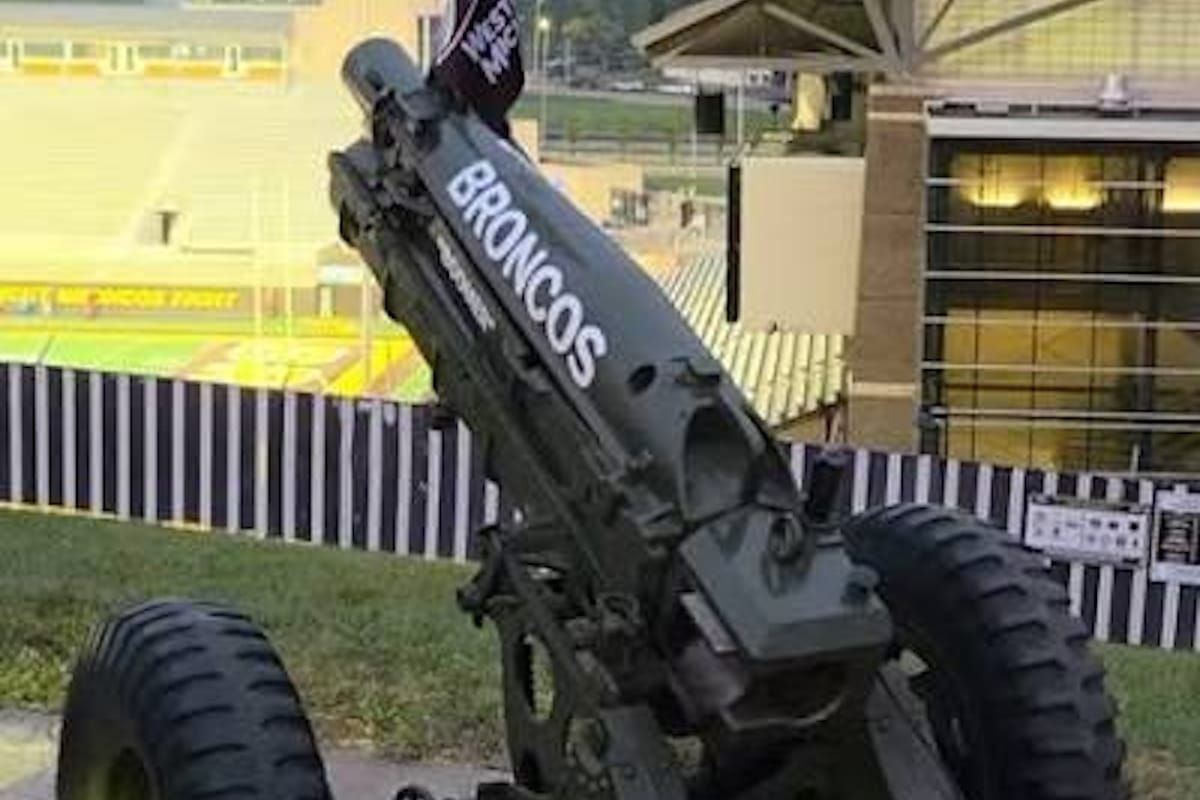
He’s also arguably the key figure in procuring and establishing what’s become an icon of Western Michigan football: “Boomer,” the 75 millimeter pack howitzer that fires from the hill on the southeast corner of Waldo Stadium.
“We used to have drawings, with sorority or fraternity kids, have somebody come over, pull the lanyard,” Guilfoyle said. “That worked pretty well for a while.”
While Boomer is the most visible legacy of Guilfoyle and his ROTC cohorts’ time at Western Michigan and in the ROTC program, it’s merely part of a time where Guilfoyle and his cadre were ready to serve the university and vice versa. In a recent interview with Mitten Football, Guilfoyle recalled how Boomer came to be and so much more of how the ROTC program supported Western Michigan football, the university, and vice versa.
“But the support for the football team and the university is far, far, far beyond what anybody else would've done,” Guilfoyle said.
Before there ever was a cannon sitting up on the hill at Waldo Stadium, then head football coach Al Molde came to Guilfoyle and asked for more noise. That was in the mid-to-late 1980s.
The first option, a shotgun fired into a barrel, didn’t really meet muster. The next option was assuredly overkill.
Guilfoyle had managed to get ahold of a 105 millimeter howitzer cannon, among the bigger shell sizes possible. Not much had happened in the game, Guilfoyle remembered, and he opted to fire the cannon at halftime, because in his words, “I came a long God damn way to fire this cannon.”
So as the Broncos and their opponent scuttled into the halftime locker room, Guilfoyle fired a paraffin blank, aimed away from the stadium toward some pine trees with additional buildings behind them.
“Every face in that place turned to Oakland Gym, waiting for it to fall down,” Guilfoyle said, referencing the old structure where ROTC was housed, where the Donald Seelye Athletic Center sits now. “I could see every face in that stadium looking at me. This humongous smoke cloud put over the stadium. And when they realized a place was not gonna fall down, the band starts. That's the funniest thing, the most memorable thing I've gotten from my time there.”
There were other issues with the 105, too. Guilfoyle had to make a regular drive to Fort Sheridan in Illinois to retrieve the spare cannon for them to use, and one of his fellow non-commissioned officers in the ROTC instructor group drove up to Camp Grayling for the shells.
But Guilfoyle wanted ROTC to hold up its end of the bargain for Molde and the football program in bringing more noise and support.
David Corstange, then an associate athletic director at WMU, tipped off Guilfoyle about a surplus 75 millimeter pack howitzer rusting out in Portage scrap yard. Guilfoyle went and checked it out.
It was in rough shape, having sat out in front of a VFW hall for a number of years before the City of Portage had taken possession. The tires were dry rotted and plenty of rust had to be addressed, plus the necessary de-militarization all loomed as needing work.
“It was sad. Pretty rough,” Guilfoyle said.
Still, it would fit the bill, and Guilfoyle and Co. gladly took it off the hands of the City of Portage.
The national guard supplied a set of new tires and de-militarized the gun, welding a tack around the inside of the barrel to make it impossible to fire a round out of it. ROTC units are not meant to casually have fully operable artillery pieces.
But plenty of cosmetic work remained, and Guilfoyle turned to the grounds department at Western Michigan, which helped sandblast and paint the cannon, adorned with a stenciled “BRONCOS” on the barrel.
“So it was, you know, a cooperative effort between a lot of different groups,” Guilfoyle said. “And Boomer's born.”
The actual nickname of “Boomer” came around shortly after, with a group of cadets adorning the cannon with that moniker, one that’s stuck now for decades.
And Guilfoyle always had a hunch it would stick.
“I thought we would be there for a long time,” Guilfoyle said.
That Guilfoyle could get help from the grounds department to resurrect Boomer, or that the football staff felt comfortable coming to him to get some support from ROTC, stems from a university culture that Guilfoyle remembered as being collaborative and egalitarian at the time. Every department, seemingly, could find a way to help each other out, and vice versa.
So as much as he got help for things with ROTC, like a delivery of dirt from some other university department for a repelling tower that the ROTC battalion wanted, they helped out too.
Guilfoyle recalled being asked to help move some university archives. He could only offer up one training day, three hours in total, but had his cadets formulate a plan and execute it. They got a lot moved, he said, and got paid in pizza — a much better deal than what the university paid for movers to help finish the job.
 Andrew Graham
 Andrew Graham
There were tensions, too.
In the post-Vietnam zeitgeist, institutional outcroppings of the United States armed forces were not always popular on college campuses. There were plenty of times the general student body, ROTC and administration were not seeing eye to eye, as Guilfoyle recalls, on various issues.
But those tensions seemingly always had a release valve. It was just a matter of finding it.
Guilfoyle recalls once being approached by a theatre group and professor to take part in a stage production about the Vietnam War. He had his skepticism, but ended up getting to be a drill sergeant for a group of theatre performers.
“I put my drill sergeant hat on, I had a good time,” Guilfoyle said. “And the play was great. Oh, yeah. The play was good.”
Much of the historical record about Boomer, Guilfoyle — and the role of David Corstange and others in making it occur — has been washed away by the passage of time. Newspaper clippings are slim, and a bunch of information kept about Boomer seemingly got lost when the ROTC program moved out of Oakland Gym in 2003 as the Seelye Center went up. A comprehensive history of the gun — which this is very much not — is elusive.
There’s still a cache of documents and clippings that the WMU ROTC battalion has on hand, but nothing that compares to what someone like Guilfoyle can share, stories that bear the work of preserving so we can remember how a cannon at Waldo Stadium came to be.
And stories we preserve so we can revisit days like Nov. 11, 1989, Veterans Day, days after the Berlin Wall fell.
Molde had again come to Guilfoyle, and the football program wanted to make sure attendance stayed up and that the Veterans Day game — an eventual one-point loss to Bowling Green — was a real event, not just a football game.
Guilfoyle went to work.
“'What can you do for us?'” Guilfoyle remembers Molde asking. “I said, 'I don't know. Let me think about it. What would you like?' 'Well, I would like to see some military equipment. That would be nice.' We reached out to every VA organization within I think 10 miles and allowed them, offered to them to have their color guard on the field. So we had probably 10 or 15. Went to Fort Sheridan, got 50 state flags. And my cadets carried the 50 states flags. We reached out to every military organization that was in a reasonable distance. I had an M1 tank. I had artillery. I had firefighting equipment from the airport. I had bridge boats from the Marines. I had two helicopters. They landed in the baseball field. And the baseball coach was not happy about that.”
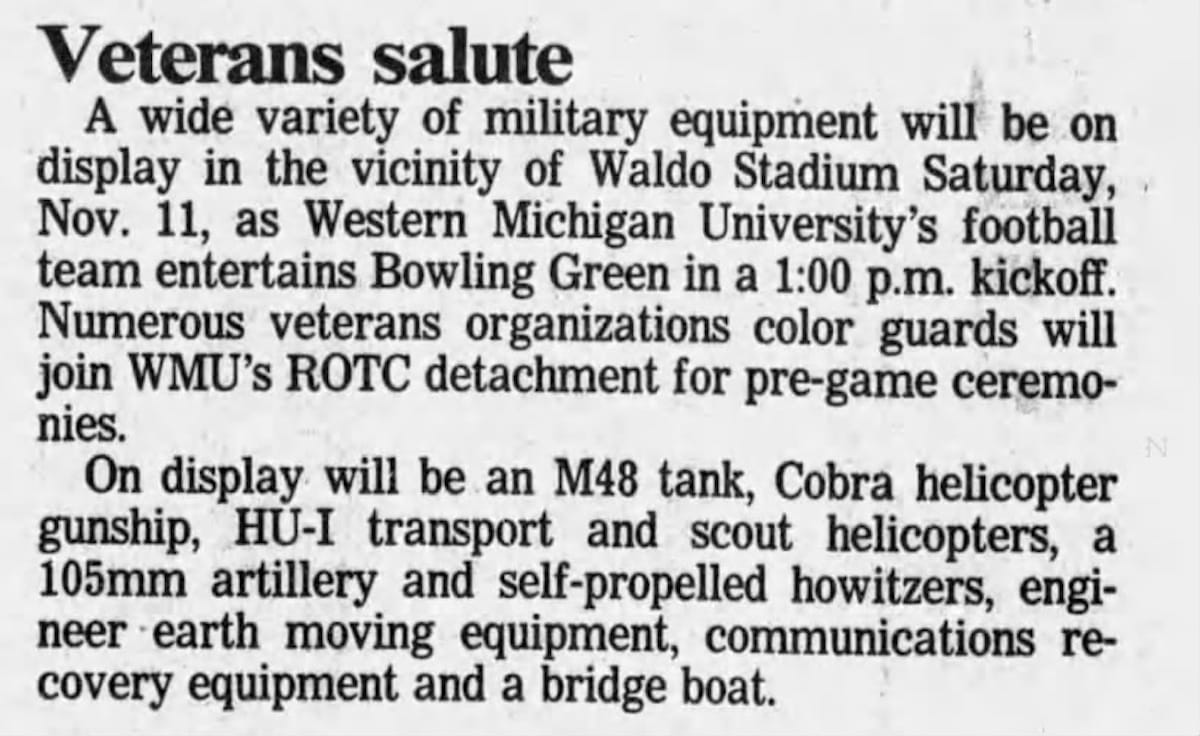
A Kalamazoo Gazette clipping from Nov. 4, 1989, outlines the planned event.
“On display will be an M48 tank, Cobra helicopter gunship, HU-I transport and scout helicopters, a 105mm artillery and self-propelled howitzers, engineer earth moving equipment, communications recovery equipment and a bridge boat.”
That weekend was not without hiccups, too. There had been a fire in a supply room in Oakland Gym, and amidst the investigation into that, a professor of military science (PMS) from either Michigan or Michigan State (Guilfoyle couldn’t remember precisely), was also visiting.
Amidst all that, Guilfoyle had the tank set to be delivered and parked outside of Oakland Gym for a static display, something the police and other authorities were not exactly keen on as it arrived. They were particularly concerned about what the tank treads would do to a freshly repaved parking lot.
Eventually some higher-ups got involved, and the tank was allowed to drive into place for an upcoming football game.
The visiting professor could hardly believe what he’d just witnessed and approached Guilfoyle.
“A group that doesn't really have the support of the university like we did,” Guilfoyle said of other ROTC programs. “He comes up, ‘How the f*** do you do this?’ We asked for it. We did our research, and the university supported it. There it is.”