‘Light switch fixes,’ small places and Tommy Boy: How Central Michigan’s offense can start shifting into gear
The Chippewas have struggled notably through two games on offense and are looking to clean up the small things in hopes of exponential benefits.
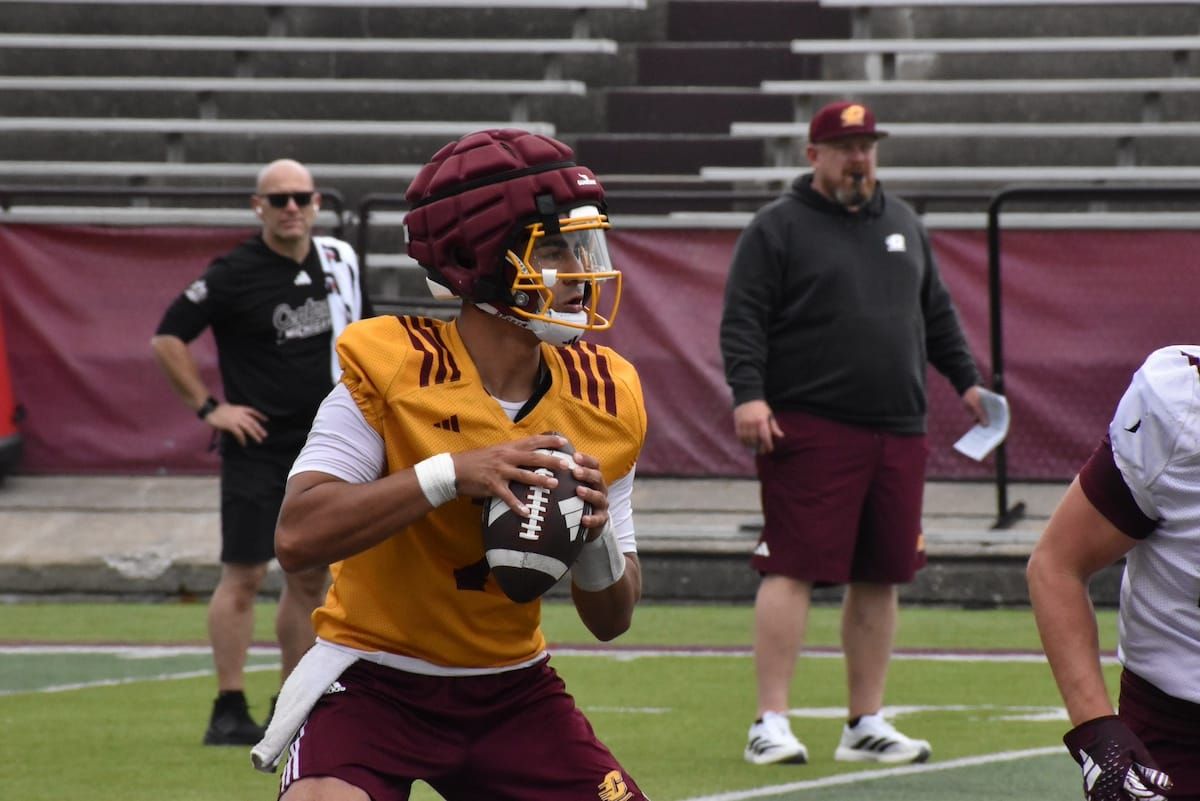
Mt. Pleasant — Central Michigan’s offense has been bad through two games, and those in maroon and gold in the Chippewa Champions Center know this.
But how it gets better, starting against Wyoming (1-1) this Saturday at 1 p.m., when so much is going wrong, is a somewhat fraught question. What do the Chippewas need to fix, and what can even be improved in a week? The answer is to start small, with things like cleaning up ball fake mechanics in the backfield.
“And then 500 other little minuscule things are [also at fault],” head coach Matt Drinkall said. “It's, the lack of production is death by a thousand cuts. And that's — if you want to see big changes, look in small places.”
Central Michigan (1-1) is hoping the form it found in the second half vs. Colgate, when the run game got going and led to 13 points, can be a foundation to build out improved offensive performances week over week. And after feeling the offense spool up into any successful form for even a half, the Chippewas have a dose of confidence as they approach addressing the myriad issues that have hamstrung the offense so far. There is no silver bullet, Drinkall said, but a series of minor cascading failures that, if cleaned up, can lend to exponentially better on-field performance.
“At least everything was functioning at the right RPMs,” Drinkall said. “And it's awesome because where we are at now, I have a different job and responsibility than our fans do. Our fans should want us to score a touchdown on every possession on every play and win every game by 50 points.”
As Drinkall diagnosed and described what ailed his team's offense through two weeks, he quickly gets to the central point: It’s not one thing.
From the offensive line to the quarterbacks to the running backs to the pass catchers, everyone shares some blame, and everyone can improve in some way.
The staff identified a lack of urgency, focus and fervor after Week 1, and Drinkall outlined how he planned to fix that going forward, namely by tweaking practices. And while the downstream benefits of those changes to practice and focus on dialing the team in ahead of games might not pan out in a week, it’s those sort of “light switch fixes” that the Central Michigan staff wants to prioritize.
“There are some problems that you need to accumulate reps, you know what I mean?” Drinkall said. “Like, there's no — if I want to go learn how to play piano, that's not a light switch fix. I need reps to do that. If I need to be a more positive leader, that is a light switch fix for me. There is nothing that can prevent me from doing that right now, today, making a switch. So we're trying to find a lot of our issues that have led to our lack of production in all three phases, not just offense, have been our light switch fixes that we can address.”
At the core of the light switch fix philosophy is the notion of it being something controlled, something that can be changed within a person, position group or team by a choice in their own behavior. So whether it’s running through some drills with more effort and intensity in practice, changing tack on a coaching approach, or perhaps even eschewing certain play calls, the Chippewas are turning over plenty of stones — or flipping a lot of switches, rather — that they believe can improve the performance on offense.
 Andrew Graham
 Andrew Graham
At times on the field in early games, the mechanics around some of CMU’s plays have felt slow and clunky, with blockers out of place as lagging ball fake mechanics between quarterbacks and skill players turn the offensive backfield into quicksand.
And the difference between those backfield machinations being quick, reactive and a second-nature feeling (which is the ideal) and the current bogged-down nature is something that quarterback Angel Flores has noticed.
He suspects that operation getting tightened up across all parts of the offense, from the line to the quarterbacks to the skill players, can pay dividends.
“A lot of plays happen like that,” Flores said. “It's like small little details, like a small holding or like a, like you said, a bobbled ball through the mesh on some of the plays. Like, those are the differences between a 15 yard gain or a 10 yard penalty that sets us back. And we're now 2nd and 15, 3rd and 15. So instead of setting it up for 1st and 10, you know, we're behind the sticks and stuff.”
In looking at the countless small things, Drinkall and Co. are trying to be conscious of not creating a mental overload that bogs down their players on the field.
They’re on a cliff’s edge, and putting more and more on the players could see them fall off it. Or, as Drinkall alluded, have it feel like the scene from Tommy Boy when, early in the movie, a hapless and overwhelmed Tom Callahan catastrophically fails at making a sale — and makes a fool of himself in the process.
“It's just, there are some schools right now that, in college football, there are schools right now that have the ability to get a guy in your building and keep them there for a long, long, long, long time,” Drinkall said. “They are at different points in their season than schools that don't do that. Assuming they're all going to be at the same point in the race, is probably unrealistic. So I am — for us, now at the same point too, season has started, it's not like you can sit and be like, ‘Hey, we'll get it in two years.’ So you can't do that either. So it's like there has to be a sense of urgency of how do you address it and fix it without doing too much to where you’re Tommy Boy making a sale, you know?”
Ultimately, Central Michigan is well aware it needs to get better on offense, and fast. The coaches and players are also aware they can’t fix this overnight, but are diligently working on making all the small fixes that could lead to big improvements.
Because what’s been clear for all involved through two games is that what the Chippewas have been doing on offense is not nearly good enough.
“The good part is, like, we haven't been as productive as we have to be, for a million reasons, but it's mostly self-inflicted things that the longer we look in the mirror and the longer we get to attack it and practice, the better we're gonna be,” Drinkall said.