Western Michigan, NBC, the Big Ten and making sense of a ‘known discrepancy’
The Bronco brass went out of their way to get on top of the biggest controversy in college football, something that couldn't be said of the two entities that ostensibly caused it.
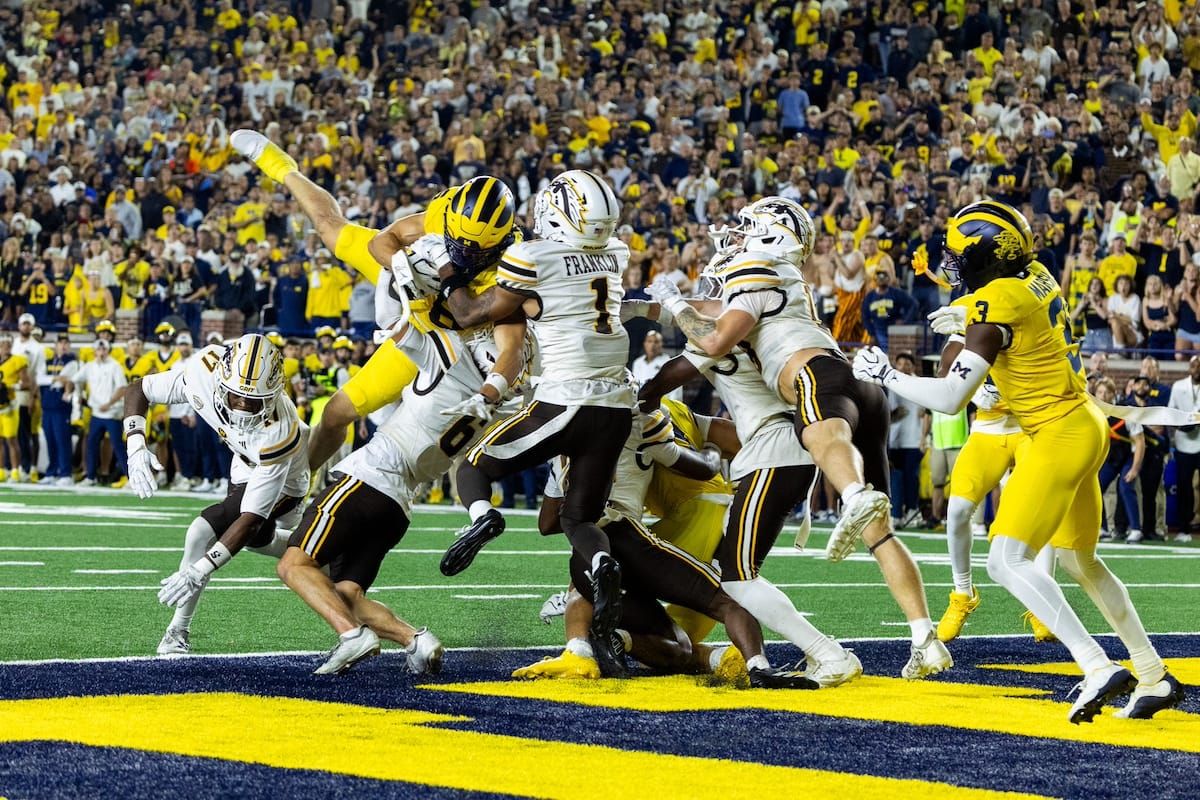
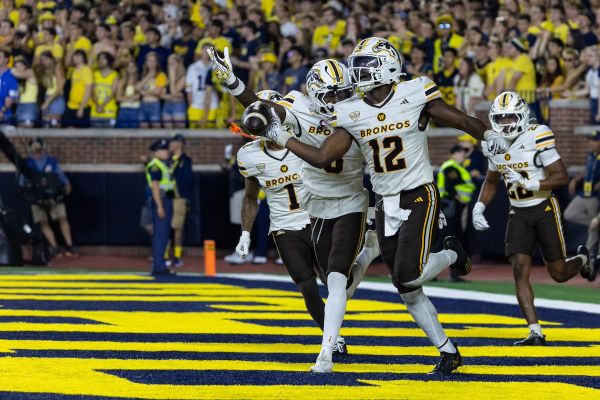
The result on the field — 13-12, Michigan over Western Michigan — might be settled from Saturday evening’s season opener at Michigan Stadium, but the matter of the clock disparity debacle between NBC’s broadcast and the Big Ten’s replay setup took supremacy on Sunday after the controversial ending.
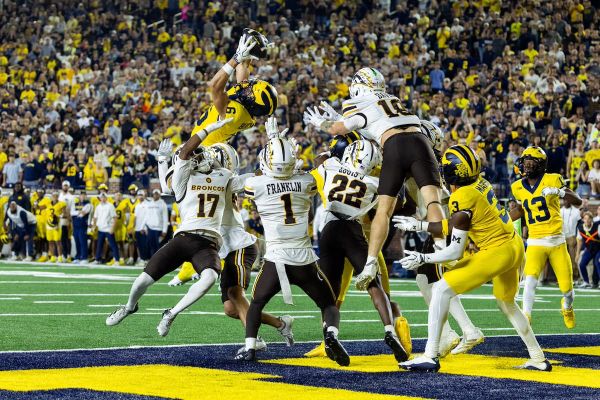
To recap: Michigan got a final shot at a Hail Mary and walked off with a win on that play after officials reviewed the first heave attempt, which fell incomplete, and determined there was one second left, all despite the NBC broadcast of the game showing a supposedly synced up game clock that went to zero well before the play was dead.
Furor ensued. The Big Ten provided its explanation around 1 a.m. ET, well after the wildfires of speculation roared out of control, fueled by NBC’s telecast showing what looked like robbery. The MAC assented shortly after via its own statement, as the Big Ten had shared a clip of its replay feed showing one second remained.
“Following video review, it was determined Western Michigan’s No. 18 started his jump from an established out-of-bounds position (left foot) and made contact with the ball with one second remaining on the clock. As shown in the provided video of what was viewed during the replay process, a side-by-side view of the play and game clock, using a direct shot of the game clock in the stadium, was used to determine the final ruling,” the Big Ten’s statement read in part.
NBC briefly addressed the matter on Sunday, with studio host John Fanta reading a prepared statement.
“The official time of the game is kept by the Big Ten,” the statement said in part. “Our cameras are not the official arbiter of timekeeping within the game. That is the Big Ten and game officials' responsibility. After the game last night, the Big Ten released a statement and raw video from its replay process that showed how and why the decision was made.”
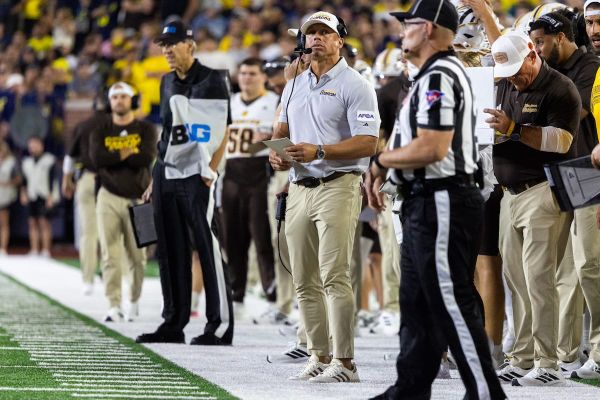
And as Michigan celebrated its improbable, arguably-undeserved-on-the-merits win, there were the Broncos, with head coach Lance Taylor and Western Michigan University president Russ Kavalhuna addressing the matter head on immediately after the game and again on Sunday after. Along with calling a press conference where Taylor and Kavalhuna spoke and took questions from media, both local and national, the duo later appeared on CNN and discussed the ending.
While the Big Ten and NBC lobbed out lawyerly statements on the clock discrepancy, the leadership braintrust for WMU football offered more information, insight and clarity into the controversy than either of the parties responsible for creating it.
“I gotta say, I'm not entirely enthused with any folks at home and referees seeing different video,” Kavalhuna said to CNN’s Omar Jimenez. “But the truth is, we gotta go forward. And this football team played its tail off, and were clearly the better team on the field, and I'm really proud of that.”
To attempt to explain what happened with the NBC broadcast and the referee’s replay feed having different times, it's helpful to start at the foundation of timekeeping.
The clock — the official 60 minute timer for a football game — is usually run by a timekeeper, often via a digital interface in the press box these days. This is the same clock that is displayed on the scoreboards in the stadium via analog displays in most stadiums, including Michigan Stadium. That system runs and exists independently of the referees (hence requests to put time back on the clock) and the television broadcast.
Because both the television broadcasts and replay apparatus rely on having their respective systems synced with the scoreboard clock display, they each independently have a camera trained on it. From that feed, the rest of the cameras and graphics packages can be synced up with the game.
So, to recap, the official game clock is kept independently and shown on the scoreboard, with NBC and the referees, independently of one another, syncing their systems to the scoreboard clock via a direct camera shot.
The Big Ten statement explained in brief how it synchronizes the replay system using a strobe: “85 minutes prior to the game, all broadcast cameras used for the replay system, including the camera on the game clock, are synced using a strobe system to ensure all cameras are aligned.”
NBC’s statement did not offer any explanation as to how it synchronizes its telecast with the game clock.
 Andrew Graham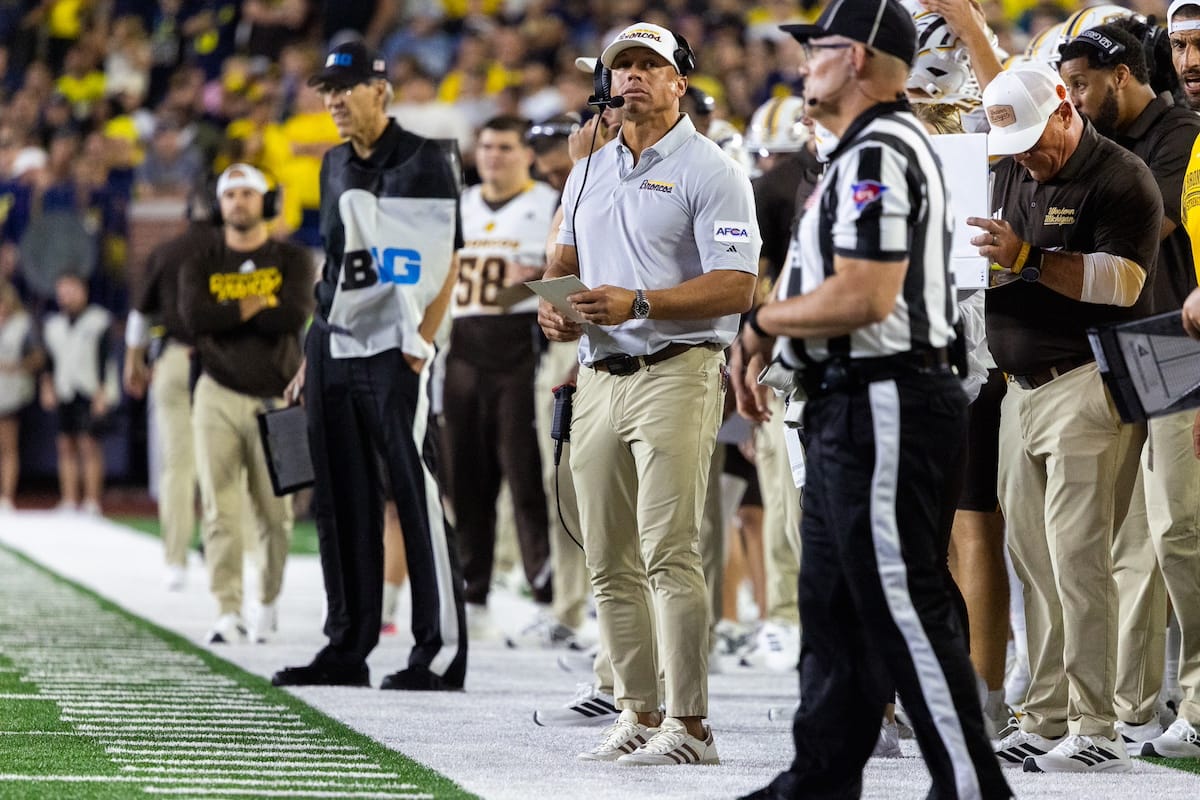
 Andrew Graham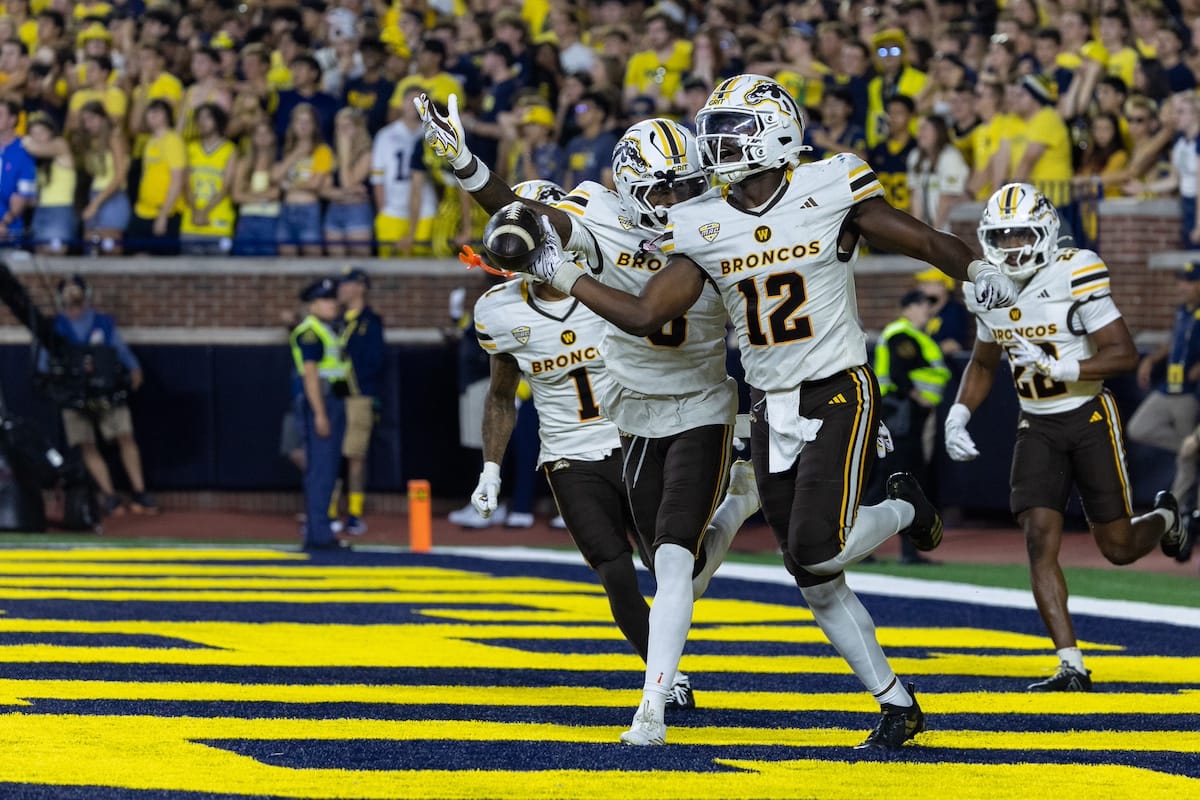
With the two entities working in parallel to synchronize their own independent systems, the opening for a discrepancy is evident.
The Big Ten treated the replay clock as the definitive arbiter of the clock in the moment, with its side-by-side feed of the final play and the scoreboard clock showing one second remained.
After speaking in depth with Big Ten commissioner Tony Petitti overnight, Kavalhuna shared on the press call on Sunday that this is a “known discrepancy.”
“I did ask the commissioner that direct question,” Kavalhuna said about the differences between the NBC clock feed and the replay review clock feed. “And he was candid that that is a known discrepancy. And it’s through a thoughtful process that they’ve made that decision. And beyond that — and I believe the Big Ten has thought through that. I had a very hyper-technical conversation about the actual cameras that are used, the feed that goes to which entity, who controls which, but that is something you’ll have to ask the Big Ten.
Mitten Football has reached out to both the Big Ten and NBC for comment with questions about this being a “known discrepancy.”
And for all the appearances of impropriety, Kavalhuna, a former federal prosecutor, emphasized that he scrutinized the situation and didn’t “discern anything unfair or untoward.”
The problem, seemingly, is not the decision itself but the confusion and dearth of rapid transparency after the fact — or in the first place, if this discrepancy was truly known prior.
It took the Big Ten until nearly 1 a.m. to release the short clip of the replay video feed with audio of the deliberations included, something that should arguably be part of live broadcasts to begin with. And its public disclosure is apparently something Kavalhuna prodded the league on.
“I've seen the two videos, and at my request, the Big Ten disclosed that video that they relied on,” Kavalhuna said on CNN on Sunday.
NBC has essentially punted responsibility on the situation to the Big Ten, and the league seems loathe to openly criticize a broadcast partner, though one can read between the lines on the league’s statement.
Regardless, NBC’s broadcast was the definitive look for millions of people for several hours, and that look showed that Michigan was given a play it shouldn’t have gotten, even if it turned out to be incorrect relative to what the referees and Big Ten adjudicated the game from.
And the vacuum of explanation got filled by Kavalhuna and Taylor, who did more to put out fires they’d just been burned by than is reasonable to expect.
Kavalhuna acknowledged the raw, human nature of it all, recalling a locker room of players and coaches who felt, and still probably feel, that they had something rightfully theirs ripped away. He himself acknowledged how disappointed he was in the moment and that he isn’t just satisfied with their being no recourse or appeal for the Broncos.
But perhaps the most important message coming from Kavalhuna and Taylor on Sunday is how the Broncos plan not to pout or, in Taylor’s words, be bitter, but instead steel their collective jaw, accept that the ending on Saturday night might never feel fair or right, and succeed in spite of being knocked on their ass.
“Each of those kids came into this game being told they were gonna get destroyed. And then in the first quarter, they get scored on, and it looks that way,” Kavalhuna said on the call with press. “And this is the thing that I hope people look at: Because the truth is coach is really, really competitive, and so am I, and we really wanted to win that game. But the truth is, we're here because we really are invested in the idea that if we work hard with young people and help them grow, we're gonna build better citizens and better teammates. and better spouses and better members of our community. And when you are part of this world, you are going to get knocked down. And it's gonna hurt. And sometimes you're even gonna think it's unfair. And that's what those kids felt.
“Imagine the wrenching pain that Coach and I saw in that locker room. But then, look at what you saw. You saw a bunch of young men who had something that they worked so hard for as a team, taken away from them, right at the last second, in a way that they wouldn't have ever dreamed. And then they, as professionals, and as teammates, gracefully exited the field. They came into the locker room. I didn't see any tantrums. I didn't see any breaking down of the team. What I saw was a team. And I think that's what Western Michigan University should be known for.”