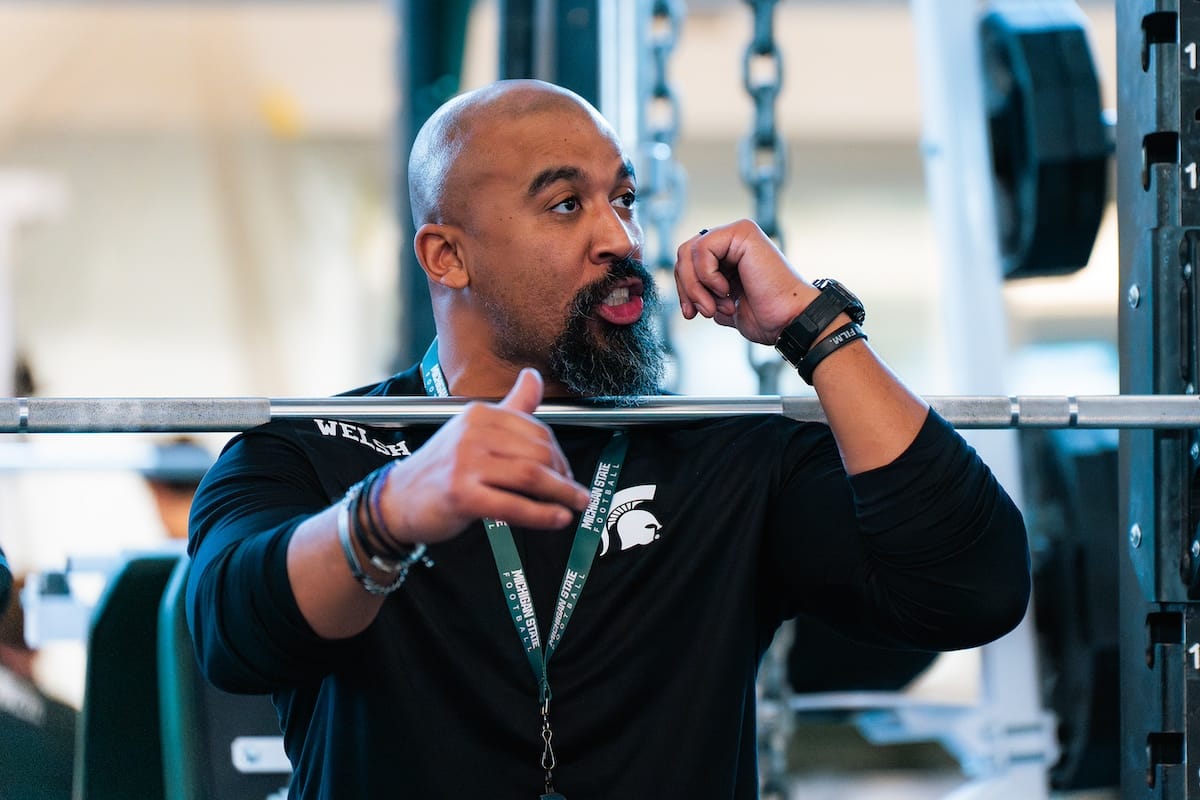
Strength coach Joel Welsh fueling MSU’s new culture, toughness: ‘We know who the hell we are’
Welsh arrived in East Lansing from Mt. Pleasant and is setting about laying the foundations for the new MO of Michigan State football — one built on development and toughness.
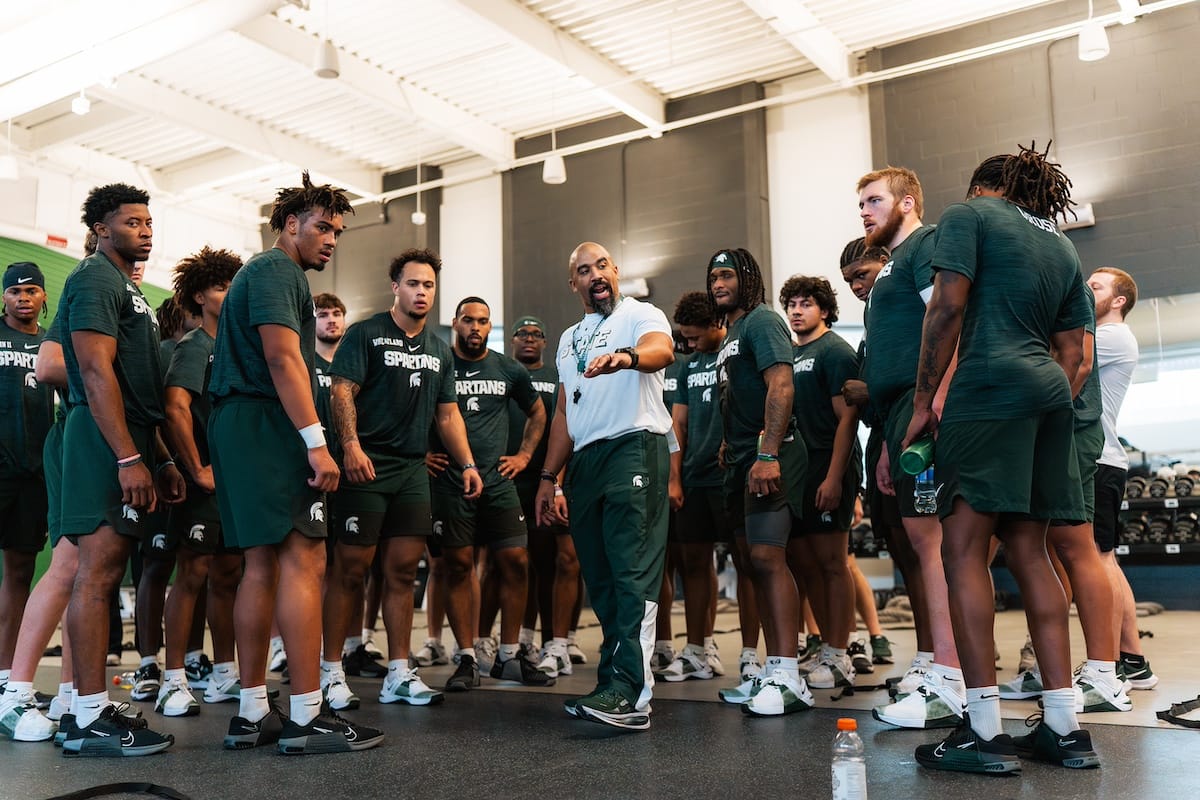
East Lansing — After about 25 minutes of talking about his and the strength staff’s role in shaping Michigan State football in Year 1 under new head coach Pat Fitzgerald, Joel Welsh drops a line that could’ve been from Jedi master Yoda.
“We talk a lot about the word try,” Welsh said in an interview with Mitten Football. “We talk a lot about eliminating the word try. Don't give yourself a plan B, go make it happen. 'Hey I'm going to try to get this done.' 'I'm going to get this done.' There's a little bit of accountability there. Just identifying the right level of language is critical. But it's understanding, them knowing themselves.”
The tao of Welsh, the new head strength and conditioning coach for MSU football, will go a long way in shaping who and what the Spartans are on the field. He and the new roster have already been hard at work over a number of weeks in the weight room, teaching and putting into practice the pillars of the program that Fitzgerald and Welsh are aligned on, things like trust, character and reputation.
“Really what I felt strongly that we needed when I got here was the standards, the expectations, the urgency, the discipline and then being fanatical — he was the one who said that to me,” Fitzgerald said. “I asked ‘What’s our plan to get our team where it needs to be?’ And he goes ‘We need to build fanatical relationships with our players.’ And after that it was kind of the, ‘You had me at hello.’”
Along with instilling the mental acumen the Spartans want to live by, Welsh and his staff are leading the charge on helping Michigan State get back to a rugged, tough, punch-you-in-the-mouth style of football that has been successful in East Lansing. Development will be a byword for the Spartans, something Welsh is familiar with from his time at Iowa working on the football staff and more recently overseeing the athletic department’s athletic performance program at Central Michigan. Fitzgerald was no stranger to the need to retain and develop players over a number of years when he coached at Northwestern, either.
“We know who the hell we are,” Welsh said. “We're going to sit here, we're going to develop our young people. We're going to grow them, they're going to gain weight, they're going to gain size, they're going to get stronger, they're going to get fast. There's a mentality that goes with development. Like development's not easy. There's a process with development, you talk about the things that aligned me and coach Fitz, it was an understanding about development.”
Things have changed in the sport, and Michigan State brought in a hefty transfer class for the 2026 season. That’s not going to be a regularity, Fitzgerald said, as he intends to build more roster continuity as he signs his own high school recruiting classes.
And that puts a premium on development, as does this winter workout cycle when Welsh and Co. have been putting new and returning faces through their paces in his weight room, trying to coalesce the various individuals into the 2026 team.
In establishing this Michigan State program early on, Welsh said, there’s been an emphasis on instilling a common language among the Spartans. That is the root of building the culture the Spartans want to live in.
But it’s not just as simple as “this is how we talk.”
It’s about first educating players on what will happen when they sign with MSU, Welsh said, as early on as recruiting. From that knowledge an expectation can be borne, with players knowing the standard and thus being able to live up to it.
The coaches will provide the direction and structure, a plan for the players to follow to find success, both in the weight room now but later, on the field, and ideally applied to their broader lives.
The culture, then, is the accumulation of the choices the players make to stick to that plan and live by the pillars.
“Identifying themselves as, 'Hey, I'm a Spartan.' But understanding what a 'Spartan' means," Welsh said. "We identify being a Spartan because being a Spartan means we're going to do our jobs at a high level. We recognize that we're going to go, we're going to give our absolute best, our best effort every single day. Those are the things we want to build our culture around. And part of building our culture is making sure we're educating our young people and what are the pillars that go into building the Spartan program.”
The pillars — there 10, Fitzgerald said during his signing day press conference — are something that the Spartans talk about each Wednesday, with Welsh leading the talks.
Read more coverage from Mitten Football
 Andrew Graham
 Andrew Graham
Recent talks have covered trust and reputation, and each Wednesday is about getting the players to think about and understand these concepts on a granular level.
What shapes their reputation? How is trust earned, or lost? What does it mean to trust someone? What is my reputation?
Pondering those questions, and finding good answers, can be the root of self belief that grows into successes in the weight room, the practice field and beyond, both individually and collectively, Welsh said. Because when players can sit in their own discomfort, there will be a lot less finger pointing when adversity strikes.
And if he arms the players to navigate that adversity themselves, then Welsh has really succeeded.
“But like you said, then we're holding your hand and walking you through what we said has to be done,” Welsh said. “And then we let go of your hand and we're watching you do it. 'Awesome, now you got it.' And the cool thing is, then they're able to help out others.”
As for the football itself and how Welsh and Fitzgerald want the Spartans to look, it might be music to fans’ ears.
Fitzgerald said he targeted Welsh in part because of his Iowa background, considering how the Hawkeyes are consistently one of the biggest, strongest, fastest and best conditioned teams in the Big Ten. He wanted some of that DNA with the Spartans.
Welsh cited an integral figure from the recent glory days under Mark Dantonio in East Lansing as something of a measuring stick.
“Growing up, you hear you're playing Michigan State, it's like, 'Shoot man, we gotta play Michigan State,'” Welsh said. “You know it's going to be a physical game. And you said this like, Coach Ken Mannie. I tell you that, because you knew what kind of team you were going to face. And that's pretty — to understand at this place, you can have success based on toughness and effort, that's pretty special. Not a lot of places can say that.”
So far, Welsh has been impressed with the way winter workouts have gone.
The attitude and mental adaptation has been good. Players, he thinks, are picking up on the culture as coaches are teaching it and adapting admirably to the changes, either from a new coaching staff, or new everything, in the case of the transfers and freshmen.
And the workouts themselves have been leaving him impressed, as each player has made some notable strides in their physical development. It’s something Fitzgerald and players took note of.
“We had a team meeting this morning and asked everybody to raise their hand who gained weight, everybody’s hand went up,” Fitzgerald said on Feb. 6. “Who’s added strength? Everybody’s hand went up.”
For Welsh, personally, it’s been a fun experience diving into the new job in the past few weeks. He had known Fitzgerald from afar and shared acquaintances, but hit it off when Fitzgerald approached him for the job, as the two are simpatico on how the Spartans can rise to be a force in the Big Ten.
More specifically, he’s taken joy in getting to know all the new players he’s coaching, their goals and what drives them, and then getting to parlay that into improvements mentally and physically.
Repeatedly, Welsh highlighted the idea that what matters most for all of this is getting the right people in the building, coaches and players. He raved about the various individuals he’s gotten to work with since arriving in East Lansing.
“Having that ability to sit down with these young people and listen to them, and listening to the things that motivate them and drive them and get to know deeper who they are, that makes the job so cool,” Welsh said. “And every day you get to see people develop a little bit more. You see people figure it out. You see something click.”
And at Michigan State, working for Fitzgerald, things seem to be clicking for Welsh, too.
“When you have the right values and people that think the right way, it's interesting how everyone just kind of finds each other,” Welsh said.